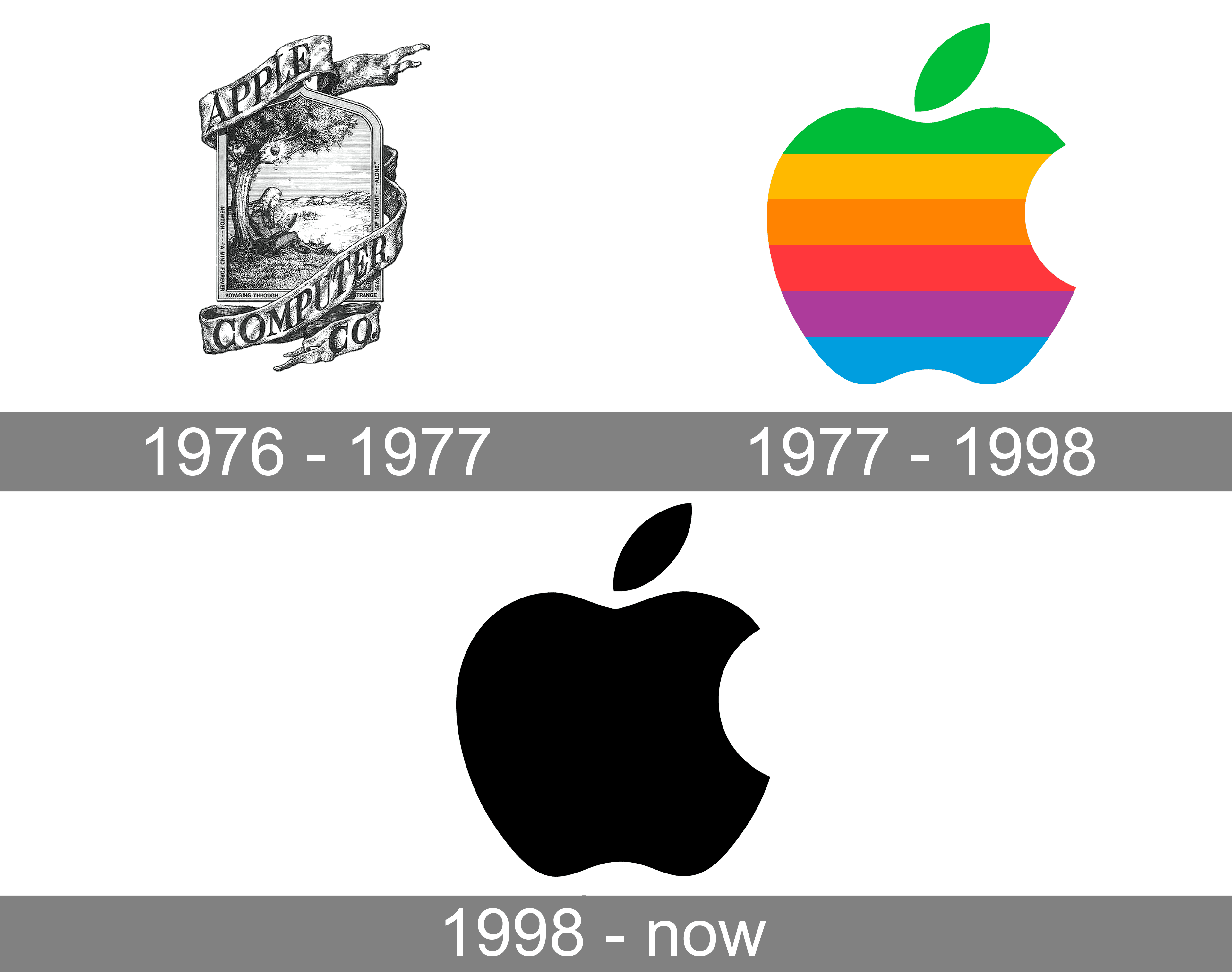
3 logo version2 baar badla1976 se shuru50 saal ka safarsabse lamba chala 1998 – Today364 events49 saal me events mile
PNG 1976 is when Apple opened its doors, and the company’s spent the decades since turning into one of the biggest names in consumer tech — phones, computers, the software and online services that tie everything together. You can see the scale of it every time something new ships: launches dominate tech news for days, and there’s always a line of people outside stores wanting to be first to get it. The logo’s kept pace with all of that. These days the bitten apple might be just as recognizable as the products carrying it. Few brands carry as much weight from a single image as Apple does. The company behind the iPhone and the Mac didn’t just build computers — it reshaped how people think about design, down to the smallest details of its packaging and interfaces. That same instinct for restraint shows up in the logo itself: a shape introduced in the late 1970s that needed almost no revision to stay relevant for nearly fifty years. Apple was founded by Steve Jobs, Steve Wozniak, and Ronald Wayne, and it was Jobs who pushed hardest for the brand’s visual discipline — simple, confident, nothing excessive. The result speaks for itself: surveys and brand studies have repeatedly ranked the Apple logo among the most recognized marks in the world, on par with brands many times its age. What’s unusual is how little the shape itself has moved since 1977. Janoff drew a silhouette, and nearly fifty years later it’s basically the same outline — stripes came and went, finishes changed, but the shape never got redrawn. Most brands redo their mark every decade just to look current. Apple never really had to. Who designed the Apple logo? Rob Janoff drew the bitten apple in 1977. At the time he was an art director at the Regis McKenna ad agency, and the idea — apple, bite taken out — was entirely his own. Steve Jobs signed off on it; Janoff has said Jobs really only gave him one note, “don’t make it cute.” The earlier 1976 emblem is a separate story — that one came from co-founder Ronald Wayne. People have come up with plenty of readings for that bite over the years. Some tie it to Adam and Eve and the apple of knowledge; others point out that “bite” and “byte” sound alike. Janoff himself has pushed back on both — he’s said Genesis wasn’t on his mind, and that he only heard about the byte pun after the logo was already done. What he’s actually said, consistently, is much simpler: without the bite, the shape risked reading as a cherry or some other round fruit, especially once it got small.
Logo timeline · kisi bhi logo par click karo
1976 – 1977
Logo #1 of 3 · ~1 saal chala
Logo me kya badla
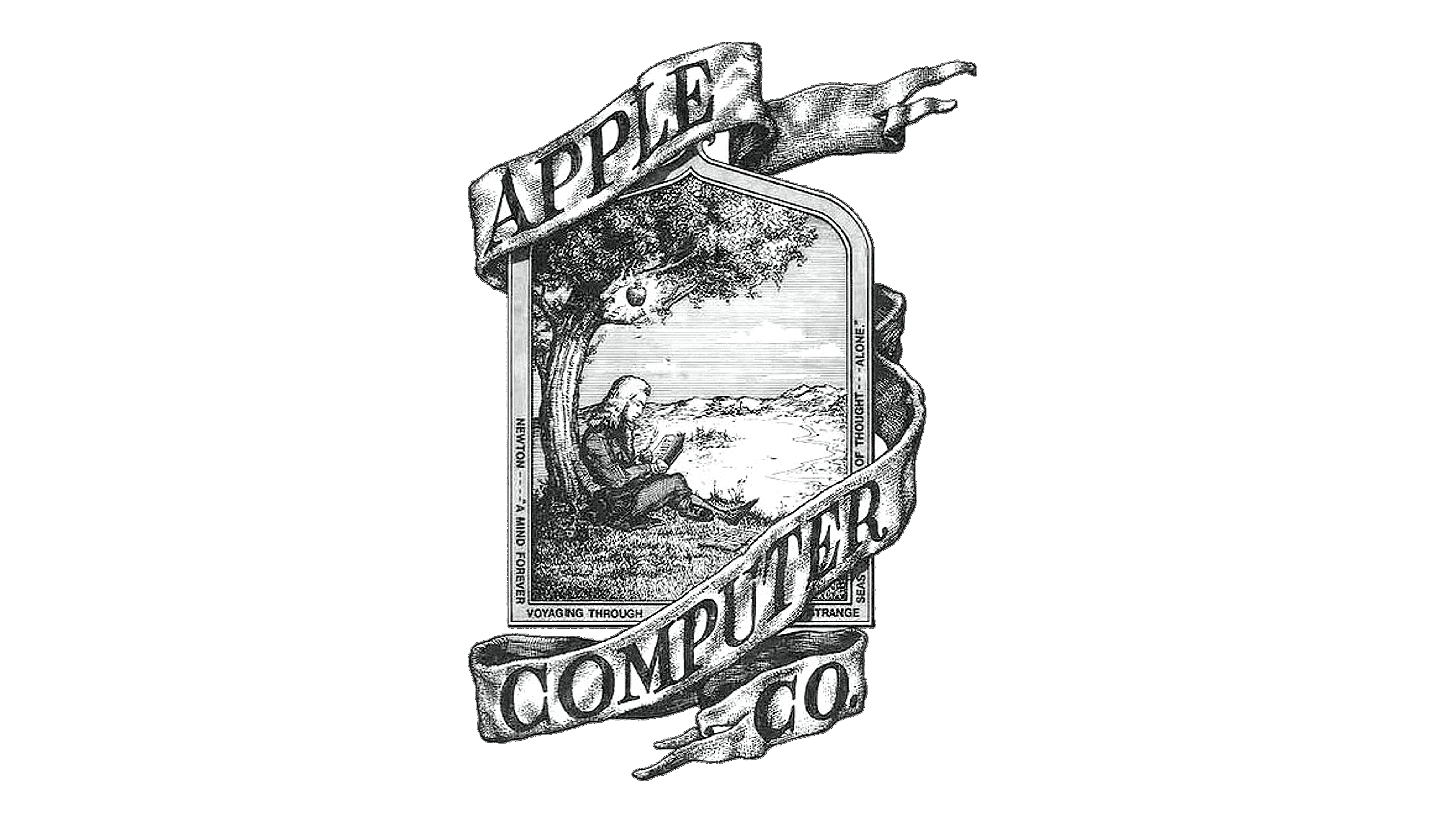
The design appeared on the cover of the Apple I’s operation manual, a surviving copy of which is held by the Computer History Museum. A rectangular panel framed in decorative ribbon carried the artwork, “Apple Computer Co” spelled out across it in heavy serif capitals. At the center, an illustrated scene showed Isaac Newton seated beneath a tree, book open on his lap, rendered with the kind of fine detail you’d expect from an old engraving. Wrapped around the border ran a line from Wordsworth: “A mind forever voyaging through strange seas of thought, alone” — a quiet nod to Newton’s solitary genius, tucked into the frame itself.
Is daur me company me kya hua
1976 – 19779 events
1956
The company sold 4.6 million shares at $22 each, raising more than $100 million, the largest IPO since Ford Motor Company's 1956 offering. 1976–1984: Founding and incorporation
1971
Steve Jobs and Steve Wozniak, referred to collectively as "the two Steves", first met in mid-1971, when their mutual friend Bill Fernandez introduced then 21-year-old Wozniak to 16-year-old Jobs. Pre-foundation
1972
Jobs later told his biographer that if it hadn't been for Wozniak's blue boxes, "there wouldn't have been an Apple." By 1972, Jobs had withdrawn from Reed College and Wozniak from UC Berkeley. Pre-foundation
1975
In 1975, the two Steves started attending meetings of the Homebrew Computer Club. Pre-foundation
1976
Wozniak demonstrated the first Apple I prototype at the Homebrew Computer Club in July 1976, where local computer retailer Byte Shop placed an order for 50 fully assembled computers. 1976–1984: Founding and incorporation
1976
By March 1, 1976, Wozniak completed the machine and took it to a Homebrew Computer Club meeting to show it off. Pre-foundation
1976
The Apple I went on sale in July 1976 as an assembled circuit board with a retail price of $666.66. Apple I and company formation
1976
In August 1976, Jobs approached his former boss at Atari, Nolan Bushnell, who recommended that he meet with Don Valentine, the founder of Sequoia Capital. Apple I and company formation
1976
Wozniak completed a working prototype of the new machine by August 1976. Apple II
1977 – 1998
Logo #2 of 3 · ~21 saal chala
· pichhle logo ke 1 saal baad
Logo me kya badla
The iconic bitten Apple logo was designed by Rob Janoff in 1977. It was a clean and perfectly balanced image, built around a horizontal six-stripe rainbow pattern. The order of the stripes wasn’t arbitrary, either — rather than following the natural spectrum, Janoff deliberately placed the green band at the top, right next to the leaf, so the color sequence would read naturally against the apple’s shape. Mostly the stripes were there to show off what the Apple II could do with color graphics — and to make a young computer company feel a bit more approachable, a bit less intimidating to newcomers. The shape never changed for over two decades. Neither did the rainbow palette, not until 1998.
Is daur me company me kya hua
1977 – 1998107 events
1977
Apple Computer, Inc. was incorporated in Cupertino, California, on January 3, 1977, without Wayne, who had left and sold his share of the company back to Jobs and Wozniak for $800 (equivalent to $4,530 in 2025) twelve days after its founding. 1976–1984: Founding and incorporation
1977
In February 1977, Markkula recruited Michael Scott from National Semiconductor to serve as the first president and CEO of Apple Computer, as the two Steves were both insufficiently experienced and he was not interested in taking that position himself. Apple I and company formation
1977
Between September 1977 and September 1980, annual sales increased from $775,000 to 118 million, an average annual growth rate of 533%. 1976–1984: Founding and incorporation
1977
The two Steves presented the Apple II computer to the public at the first West Coast Computer Faire on April 16 and 17, 1977. Apple II
1977
It was replaced in 1977 by a rainbow-colored silhouette of an apple with a bite taken out of it, designed by Rob Janoff. Branding
1977
In the May 1977 issue of Byte, Wozniak said of the Apple II design, "To me, a personal computer should be small, reliable, convenient to use, and inexpensive." The Apple II went on sale on June 10, 1977, with a retail price of $1,298. Apple II
1977
The Apple II was one of the three "1977 Trinity" computers generally credited with creating the home computer market (the other two being the Commodore PET and the Tandy Corporation TRS-80). Apple II
1978
Apple introduced the Disk II 5+1⁄4-inch floppy disk drive in 1978, replacing cassette tape storage with faster and more reliable removable disks. 1976–1984: Founding and incorporation
1978
The II still sold well, with Apple being the leading computer manufacturer in the United States where 7 million units were sold between 1978 and 1982. Competition from the IBM PC
1978
While early Apple II models use ordinary cassette tapes as storage devices, they were superseded in 1978 by the introduction of a 5+1⁄4-inch floppy disk drive and interface called the Disk II. Apple II
1978
The development of the Apple III started in late 1978 under the guidance of Wendell Sander, and was subsequently developed by a committee headed by Jobs. Apple III
1979
In 1979, the Apple II was chosen to be the desktop platform for what became the first killer application of the business world: VisiCalc, a spreadsheet. Apple II
1979
In 1979, in return for the right to purchase $1 million worth of Apple’s pre-IPO stock, Xerox granted Apple access to its Palo Alto Research Center (PARC). Xerox PARC and the Lisa
1979
The Apple II became Apple's first major commercial success following the 1979 release of VisiCalc, the first widely adopted spreadsheet program and one of the earliest personal computer "killer applications". 1976–1984: Founding and incorporation
1979
In November and December 1979, Apple employees, including Jobs and Jef Raskin, visited Xerox PARC twice as part of a technology exchange negotiated by Jobs, in which Xerox was granted the right to purchase $1 million of Apple's pre-IPO stock. 1976–1984: Founding and incorporation
1979
Jobs, along with his Apple colleagues, visited PARC twice in November and December of 1979, and he was greatly impressed by the advanced graphical user interface (GUI) of the Xerox Alto computer. Xerox PARC and the Lisa
1979
After the visits to PARC, Jobs decided to implement a GUI like the one he had seen there in the Apple Lisa, a business-oriented computer that had been under development at Apple since July 1979. Xerox PARC and the Lisa
1979
The Macintosh project was started in September 1979 by Jeff Raskin, an early Apple employee and a computer scientist. Macintosh and the "1984" commercial
1980
On December 12, 1980, Apple became a public company through an initial public offering (IPO) on the Nasdaq. 1976–1984: Founding and incorporation
1980
The facility, which opened in 1980, houses 5,500 people and was Apple's first location outside of the United States. Offices
1980
The Apple III was first announced on May 19, 1980, with a retail price ranging from $4,340 to $7,800, and released in November 1980. Apple III
1980
On December 12, 1980, Apple went public on the NASDAQ stock exchange with the ticker symbol "AAPL", selling 4.6 million shares at $22 per share ($.10 per share when adjusting for stock splits as of November 30, 2020), generating over $100 million, which was more capital than any IPO since Ford Motor Company in 1956. Apple IPO
1980
In the July 1980 issue of Kilobaud Microcomputing, publisher Wayne Green stated that "the best consumer ads I've seen have been those by Apple. Apple IPO
1980
Jobs took the lead of the Lisa project from early 1980, but the development of the Lisa was disrupted due to his excessive technical demands. Xerox PARC and the Lisa
1980
Apple originally went public on December 12, 1980, with an initial public offering at US$22.00 per share. Stock
1980
In September 1980, Jobs was removed from the Lisa project. Xerox PARC and the Lisa
1981
Jobs was removed from the Lisa project during its early development and joined the Macintosh division in 1981. 1976–1984: Founding and incorporation
1981
In January 1981, Apple held its first shareholders meeting as a public company in the Flint Center, a large auditorium at nearby De Anza College (which is often used for symphony concerts) to handle the larger numbers of shareholders post-IPO. Apple IPO
1981
The project entered a new phase when Steve Jobs, having been removed from the Lisa project, joined the team in January 1981. Macintosh and the "1984" commercial
1981
By August 1981 Apple was among the three largest microcomputer companies, perhaps having replaced Radio Shack as the leader; revenue in the first half of the year had already exceeded 1980's $118 million, and InfoWorld reported that lack of production capacity was constraining growth. Competition from the IBM PC
1981
Wozniak had already stepped away from day-to-day operations following a 1981 plane crash. 1984–1991: Success with Macintosh
1983
Apple's first GUI-based computer, the Apple Lisa, was introduced in 1983. 1976–1984: Founding and incorporation
1983
Apple introduced the Lisa in 1983 and the Macintosh in 1984, popularizing graphical user interfaces navigated by a mouse.
1983
A new model was introduced in 1983 to try to rectify the problems, but the damage was already done. Apple III
1983
The company announced the Macintosh 128K to the press in October 1983, followed by an 18-page brochure included with magazines in December. Macintosh and the "1984" commercial
1983
Slow Macintosh sales led to a power struggle between Jobs and chief executive officer John Sculley, whom Jobs had recruited from PepsiCo in 1983. 1984–1991: Success with Macintosh
1983
But by 1983, the PC surpassed the Apple II as the best-selling personal computer. Competition from the IBM PC
1983
Finally released in January 1983, the Lisa featured many innovative functions such as a GUI and a mouse, but its extremely high price of US$9,995 (equivalent to $32,300 in 2025) and the lack of software compatibility drove business users away, resulting in sluggish sales. Xerox PARC and the Lisa
1984
By 1984 the press called the two companies archrivals, but IBM had $4 billion in annual PC revenue, more than twice that of Apple and as much as the sales of it and the next three companies combined. Competition from the IBM PC
1984
By 1984 computer dealers saw Apple as the only clear alternative to IBM's influence; some even promoted its products to reduce dependence on the PC. Macintosh and the "1984" commercial
1984
By the time of the "1984" television advertisement, Apple's informal culture had become a key trait that differentiated it from its competitors. Corporate culture
1984
Its debut was announced by a single national broadcast of a US$1.5 million television commercial, "1984" (equivalent to $4,600,000 in 2025). Macintosh and the "1984" commercial
1984
From the introduction of the Macintosh in 1984, with the Super Bowl XVIII advertisement "1984" to the more modern Get a Mac adverts, Apple has been recognized for its efforts toward effective advertising and marketing for its products. Advertising
1984
BYTE in 1984 stated that There are two kinds of people in the world: people who say Apple isn't just a company, it's a cause; and people who say Apple isn't a cause, it's just a company. Competition from the IBM PC
1984
And you'll see why 1984 won't be like 1984.” On January 24, 1984, the Macintosh went on sale with a retail price of $2,495. Macintosh and the "1984" commercial
1984
However, the slow processing speed and limited software led to a rapid sales decline in the second half of 1984. Macintosh and the "1984" commercial
1984
For a special post-election edition of Newsweek in November 1984, Apple spent more than US$2.5 million to buy all 39 of the advertising pages in the issue. Macintosh and the "1984" commercial
1984
Directed by Ridley Scott and aired during the third quarter of Super Bowl XVIII on January 22, 1984, it is considered a "watershed event" and a "masterpiece." The commercial alludes to George Orwell's novel Nineteen Eighty-Four which describes a dystopian future of enforced conformity. Macintosh and the "1984" commercial
1984
In April 1984 Microsoft's Multiplan migrated over from MS-DOS, followed by Microsoft Word in January 1985; in return for Microsoft's commitment to Macintosh, Apple agreed to not provide software development kits and prototype computers to companies with applications competing with Microsoft's. Macintosh and the "1984" commercial
1985
In 1985, Lotus Development introduced Lotus Jazz after the success of Lotus 1-2-3 for the IBM PC, although it was largely a flop. Macintosh and the "1984" commercial
1985
This brought Jobs back to Apple's management for the first time since 1985, and NeXT technology became the foundation of the Mac OS X operating system. Acquisition of NeXT
1985
By 1985, internal conflicts led to Jobs leaving the company to form NeXT and Wozniak stepping back from active employment.
1985
Jobs resigned from Apple in September 1985 and founded competitor NeXT, taking several Apple employees with him. 1984–1991: Success with Macintosh
1985
He left active employment at Apple in 1985, citing frustration that the company was prioritizing the Macintosh over the Apple II division, which continued to generate a significant portion of Apple's revenue during the mid-1980s. 1984–1991: Success with Macintosh
1985
Jobs, who had been ousted from the company in 1985, returned to Apple in 1997 after his company NeXT was bought by Apple.
1985
Jobs, while taking the position of chairman of the firm, had no influence over Apple's direction and resigned in September 1985, taking a number of Apple employees with him to found NeXT Inc. Jobs and Wozniak leave Apple
1985
By early 1985, the Macintosh's failure to defeat the IBM PC triggered a power struggle between Jobs and CEO John Sculley, who had been hired two years earlier by Jobs using the famous line, "Do you want to sell sugar water for the rest of your life or come with me and change the world?" Sculley and Jobs' visions for the company greatly differed. Jobs and Wozniak leave Apple
1985
After the departures of Jobs and Wozniak in 1985, Sculley shifted Apple's focus toward expanding the Macintosh platform and appointed Gassée to lead Macintosh development, placing him in the role previously held by Jobs. 1984–1991: Success with Macintosh
1985
Although its products provided 85% of Apple's sales in early 1985, the company's January 1985 annual meeting did not mention the Apple II division or employees. Jobs and Wozniak leave Apple
1985
In May 1985, the board stripped Jobs of all operational duties. 1984–1991: Success with Macintosh
1985
The article nevertheless included some of Wozniak's criticisms of Apple, and Wozniak later said "it was an accident, but it's been picked up by every book and every bit of history [since]." In April 1985, Sculley decided to remove Jobs as the general manager of the Macintosh division, and gained unanimous support from the Apple board of directors. Jobs and Wozniak leave Apple
1986
And in 1986 Apple introduced the Apple IIGS, an Apple II positioned as something of a hybrid product with a mouse-driven, Mac-like operating environment. Corporate performance
1986
In his essay From Satori to Silicon Valley (published 1986), cultural historian Theodore Roszak made the point that Apple Computer emerged from within the West Coast counterculture and the need to produce print-outs, letter labels, and databases. Pre-foundation
1986
Markkula said during Sun merger negotiations, "Since 1986, we held serious discussions with DEC, Kodak, Sony, Sun, Compaq, IBM, and other companies I'd rather not name now. Early-mid-1990s
1986
The original model evolved into the Mac Plus in 1986 and spawned the Mac SE and the Mac II in 1987 and the Mac Classic and Mac LC in 1990. The Mac family
1987
Under leadership of John Sculley, Apple issued its first corporate stock dividend on May 11, 1987. Corporate performance
1987
In March 1987, Apple introduced the Macintosh II, a modular computer with a separate monitor. 1984–1991: Success with Macintosh
1988
By 1988, Gassée was viewed by some as a potential successor to Sculley, however, the "high-right policy" he championed began to lose ground as desktop publishing software became available on IBM PC compatible computers that sold at lower prices. 1984–1991: Success with Macintosh
1989
For the first time in the company's history, sales declined in the 1989 holiday season, followed by a 20 percent drop in Apple's stock price. 1984–1991: Success with Macintosh
1989
MacAddict later described the period from 1989 to 1991 as the Macintosh's "first golden age". 1984–1991: Success with Macintosh
1989
Meanwhile, Apple attempted its first portable Macs: the failed Macintosh Portable in 1989 and then the more popular PowerBook in 1991, a landmark product that established the modern form and ergonomic layout of the laptop. The Mac family
1989
MacAddict magazine has called 1989 to 1991 the "first golden age" of the Macintosh. The Mac family
1990
Gassée left Apple at the end of 1990 and founded competitor Be Inc. in 1991, taking several Apple employees with him. 1984–1991: Success with Macintosh
1990
The company shifted its product strategy and, in October 1990, introduced three lower-cost models: the Macintosh Classic, LC, and IIsi, all of which sold well. 1984–1991: Success with Macintosh
1990
In January 1990, Sculley appointed Michael Spindler as chief operating officer, reducing Gassée's influence. 1984–1991: Success with Macintosh
1991
In 1991, Apple introduced the PowerBook line of laptop computers, whose design influenced nearly all future laptops by placing the keyboard behind a built-in pointing device, creating palm rests. 1984–1991: Success with Macintosh
1991
In 1991, Apple partnered with long-time competitor IBM and Motorola to form the AIM alliance, with the ultimate goal to create a revolutionary new computing platform, known as PReP, using IBM and Motorola hardware and Apple software. Early-mid-1990s
1993
In 1993, Apple released the Newton, an early personal digital assistant (PDA). Early-mid-1990s
1993
The consumer product flops and the rapid loss of market share to Windows sullied Apple's reputation, and in 1993 Sculley was replaced as CEO by Michael Spindler. 1991–1997: Decline and increased competition
1993
Opened in 1993 as a research and development campus, it served as Apple's headquarters from 1997 until the opening of Apple Park in 2017 and continues to house offices and laboratories. Offices
1993
Apple discontinued the Apple II in 1993 after encouraging developers and customers to transition to the Macintosh, bringing the company's longest-running product line to an end. 1991–1997: Decline and increased competition
1993
The Apple II series went on to sell about six million units in total before it was discontinued in 1993. Apple II
1994
In 1994 Apple launched eWorld, an online service providing email, news and a bulletin board system to replace AppleLink. Need for a new OS
1994
As the first step, Apple started the Power Macintosh line in 1994, using PowerPC processors from Motorola and IBM. Early-mid-1990s
1994
In 1994, Apple, IBM, and Motorola formed the AIM alliance to promote the PowerPC platform. 1991–1997: Decline and increased competition
1995
In 1995, to achieve deeper market penetration and extra revenue, Apple officially began licensing the Mac OS and Macintosh ROMs to 3rd party manufacturers. Need for a new OS
1995
Apple by the mid-1990s was nonetheless in such serious difficulty that CFO Jim Graziano in 1995 asked the board of directors to find a buyer because the company was no longer financially viable, and quit when the board refused. Early-mid-1990s
1996
In 1996, Spindler was replaced as CEO by Gil Amelio, who was hired for his reputation as a corporate rehabilitator. 1991–1997: Decline and increased competition
1996
In 1996, the struggling NeXT company beat Be Inc.'s BeOS bid to sell its operating system to Apple. Acquisition of NeXT
1996
On December 20, 1996, Apple announced it would purchase NeXT, and its NeXTstep operating system, for $429 million and 1.5 million shares of Apple stock. Acquisition of NeXT
1996
Fortune in February 1996 wrote "the company that invented the personal computer will likely disappear". Early-mid-1990s
1996
However, by 1996, Apple executives were worried that the clones were cannibalizing sales of its own high-end computers, where profit margins were highest. 1991–1997: Decline and increased competition
1997
By 1997, Apple was reporting major losses and struggling to deliver a modernized operating system, leading it to acquire NeXT, which brought Jobs back to the company.
1997
In June 1997, he anonymously sold his 1.5 million shares, sending the company's stock price lower and contributing to pressure on Amelio, whom the board ousted the following month. 1997–2007: Restructuring and return to profitability
1997
Jobs ended the Macintosh clone licensing program, and in September 1997, acquired the largest clone manufacturer, Power Computing. 1997–2007: Restructuring and return to profitability
1997
In November 1997, the online Apple Store launched and adopted a build-to-order manufacturing model similar to that used by Dell. 1997–2007: Restructuring and return to profitability
1997
Jobs relaunched Apple's online store in 1997, and opened the first two physical stores in 2001. Stores
1997
Apple had market share of over 10% until Jobs was re-hired in 1997 as interim CEO to replace Gil Amelio, and found a loophole to terminate the Macintosh OS licensing program. Need for a new OS
1997
In August 1997, Jobs stepped in as the interim CEO to begin a critical restructuring of the company's product line. Return of Steve Jobs
1997
On November 10, 1997, Apple introduced the Apple Store, an online retail store based upon the WebObjects application server the company had acquired in its purchase of NeXT. Return of Steve Jobs
1997
At the 1997 Macworld Expo, Jobs announced that Apple would begin a partnership with Microsoft, with terms including a five-year commitment from Microsoft to release Microsoft Office for Macintosh, and a US$150 million investment in Apple. Microsoft deal
1997
On July 9, 1997, Gil Amelio was ousted as CEO of Apple by the board of directors. Return of Steve Jobs
1997
In August 1997, Jobs secured a $150 million investment from Microsoft and a commitment to continue developing software for the Mac platform, an agreement widely viewed as beneficial to both companies following Microsoft's antitrust settlement with the U.S. 1997–2007: Restructuring and return to profitability
1997
By the end of 1997, Jobs had returned Apple to profitability, reporting a profit of $309 million. 1997–2007: Restructuring and return to profitability
1997
From 1997 to 2002, the slogan "Think different" was used in advertising campaigns, and is still closely associated with Apple. Advertising
1997
Seeing a need for improved retail presentation of the company's products, he began an effort in 1997 to revamp the retail program to improve the company's relationship with consumers, and hired Ron Johnson in 2000. Stores
1997
Anderson was the head of the directors in short term and obtained short-term working capital from the banks in July 1997. Return of Steve Jobs
1998 – Today
Logo #3 of 3 · ~28 saal chala
· pichhle logo ke 21 saal baad
Logo me kya badla
Apple began moving away from the rainbow look in 1998, introducing monochrome and translucent treatments around the launch of the first iMac; the rainbow version was formally phased out the following year, on August 27, 1999. From there the icon settled mostly into plain black — sometimes white, sometimes chrome — with the finish shifting depending on whatever product or surface it’s sitting on.
Is daur me company me kya hua
1998 – Today248 events
1998
The first all-new product introduced under this strategy was the iMac, unveiled on May 6, 1998. 1997–2007: Restructuring and return to profitability
1998
Apple currently produces six Mac families: iMac – Consumer all-in-one desktop computer, introduced in 1998. Mac
1998
Apple also has slogans for specific product lines—for example, "iThink, therefore iMac" was used in 1998 to promote the iMac, and "Say hello to iPhone" has been used in iPhone advertisements. Advertising
1998
Jobs subsequently instilled a new corporate philosophy of recognizable products and simple design, starting with the original iMac in 1998.
1999
In 1999, Apple introduced the Power Mac G4, which utilized the Motorola-made PowerPC 7400 containing a 128-bit instruction unit known as AltiVec, its flagship processor line. iMac, iBook, and Power Mac G4
1999
This beat the non-inflation-adjusted record for market capitalization previously set by Microsoft in 1999. 2011–2020: Post-Jobs era, new devices
1999
Apple completed the transition to the four-quadrant lineup on July 21, 1999, with the introduction of the consumer-oriented iBook laptop. 1997–2007: Restructuring and return to profitability
1999
The technology also contributed to the development of iMovie, Apple's consumer video-editing application, released in October 1999. 1997–2007: Restructuring and return to profitability
1999
On August 27, 1999, Apple dropped the rainbow scheme and began using single-color logos nearly identical in shape to the previous incarnation. Branding
2000
In 2000, Apple introduced iTools, a set of free web-based tools that included an email account, internet greeting cards called iCards, a Web site review service called iReview, and "KidSafe", to prevent children browsing inappropriate websites. Apple and "i" Web services
2000
In April 2000, Apple acquired German company Astarte, whose DVDirector DVD authoring software was repackaged as DVD Studio Pro for professionals and adapted into iDVD for consumers. 1997–2007: Restructuring and return to profitability
2000
He eventually became CEO and served in that position from January 2000 to August 2011. Return of Steve Jobs
2001
In 2001, Apple introduced Mac OS X, an operating system based on NeXT's NeXTSTEP and incorporating parts of the FreeBSD kernel. Mac OS X
2001
Alongside the Commodore PET 2001 and the TRS-80, it formed the "1977 Trinity" of influential personal computers that established the home computer market. 1976–1984: Founding and incorporation
2001
In 2001, Apple made three announcements that would shape its future direction. 1997–2007: Restructuring and return to profitability
2001
The first Apple Stores were originally opened as two locations in May 2001 by then-CEO Steve Jobs, after years of attempting but failing store-within-a-store concepts. Stores
2001
In May 2001, after much speculation, Apple announced the opening of a line of Apple retail stores, to be located throughout the major U.S. computer buying markets. Retail stores
2001
In October 2001, Apple introduced its first iPod portable digital audio player. iPod
2001
With the introduction of the successful iPod music player in 2001 and iTunes Music Store in 2003, Apple established itself as a leader in the consumer electronics and media sales industries, leading it to drop "Computer" from the company's name in 2007.
2002
In 2002, Apple acquired Nothing Real for its digital compositing application Shake, and Emagic, developer of the music production software Logic. 1997–2007: Restructuring and return to profitability
2002
In 2002, Apple also introduced iPhoto, completing the iLife software suite. 1997–2007: Restructuring and return to profitability
2002
The latter two services were canceled because of lack of success. iCards and email were integrated into Apple's .Mac subscription-based service introduced in 2002 and discontinued in mid-2008 to make way for MobileMe, coinciding with the iPhone 3G release. Apple and "i" Web services
2002
In early 2002, Apple unveiled a completely redesigned iMac, using the G4 processor and a liquid-crystal display. Moving on from colored plastics and the PowerPC G3
2002
Later in 2002, Apple released the Xserve 1U rack mounted server. Moving on from colored plastics and the PowerPC G3
2003
In 2003, Apple launched the iTunes Store, allowing customers to purchase and download music for 99¢ per song. 1997–2007: Restructuring and return to profitability
2003
Initially, Apple Stores were only in the United States, but in late 2003, Apple opened its first Apple Store abroad, in Tokyo's Ginza district. Retail store expansion
2003
Between 2003 and 2006, the price of Apple's stock increased more than tenfold, from around $6 per share (split-adjusted) to over $80. 1997–2007: Restructuring and return to profitability
2003
The iTunes Music Store was launched in April 2003, with 2 million downloads in the first 16 days. iTunes Store
2003
Music was purchased through the iTunes application, which was initially Macintosh-only; in October 2003, support for Windows was added. iTunes Store
2004
Apple opened several "larger" stores in October 2004 to capture markets where demand does not necessarily dictate a full-scale store. Retail store expansion
2004
In 2004, after creating a sizable financial base to work with, the company began experimenting with new parts from new suppliers. Moving on from colored plastics and the PowerPC G3
2004
It was followed by a store in Osaka, Japan in August 2004. Retail store expansion
2004
A version for the European Union version opened October 2004, but it was not initially available in the Republic of Ireland due to the intransigence of the Irish Recorded Music Association (IRMA) but was opened there a few months later on Thursday, January 6, 2005. iTunes Store
2004
A version for Canada opened in December 2004. iTunes Store
2004
After several iterations increasing the processing speed and screen sizes from 15" to 17" to 20" the iMac G4 was discontinued and replaced by the iMac G5 in the summer of 2004. Moving on from colored plastics and the PowerPC G3
2004
They replaced the Power Mac G5 machines as the main building block of Virginia Tech's System X, which was ranked in November 2004 as the world's seventh-fastest supercomputer. Moving on from colored plastics and the PowerPC G3
2004
A new iMac based on the G5 processor was unveiled August 31, 2004, and was made available in mid-September. Moving on from colored plastics and the PowerPC G3
2005
A store in the Bullring shopping centre in Birmingham opened in April 2005, and the Bluewater shopping centre in Dartford, Kent opened in July 2005. Retail store expansion
2005
Apple opened its first store in Canada in the middle of 2005 at the Yorkdale Shopping Centre in North York, Toronto. Retail store expansion
2005
In January 2005, Apple introduced the Mac Mini, a low-cost computer intended to attract Windows users. 1997–2007: Restructuring and return to profitability
2005
At the Worldwide Developers Conference on June 6, 2005, Jobs announced that Apple would transition the Mac from PowerPC to Intel processors over the following two years. 1997–2007: Restructuring and return to profitability
2005
According to the French regulators, the abuses occurred between 2005 and 2017 but were first discovered after a complaint by an independent reseller, eBizcuss, in 2012. Market power
2005
In a keynote address on June 6, 2005, Jobs announced that Apple would produce Intel-based Macintosh computers beginning in 2006. Intel transition
2005
Mac Mini – Consumer small form factor desktop computer, introduced in 2005. Mac
2005
Just under three months later Apple sold its 300 millionth song on March 2, 2005. iTunes Store
2005
The iPhone had been developed in secret since 2005 and was the subject of widespread speculation before its introduction. 2007–2011: Success with mobile devices
2005
Boston Consulting Group ranked Apple as the world's most innovative company every year from 2005 through 2017. Branding
2005
However, claims made by later campaigns were criticized, particularly the 2005 Power Mac ads. Advertising
2005
Speaking to software developers on June 6, 2005, Jobs said the company's share of the entire portable music device market stood at 76%. iPod
2005
In the quarter ending March 26, 2005, Apple earned US$290 million, or 34¢ a share, on sales of US$3.24 billion. iPod
2005
In October 2005, Apple released the Power Mac G5 Dual featuring a Dual-Core processor – two cores in one rather than two separate processors. Moving on from colored plastics and the PowerPC G3
2005
On October 25, 2005, the iTunes Store went live in Australia, with songs selling for A$1.69 each, albums at (generally) A$16.99 and music videos and Pixar short films at A$3.39. iTunes Store
2005
Since 2005, Apple's revenues, profits, and stock price have grown significantly. Resurgence compared to Microsoft
2006
Apple completed the transition on August 7, 2006, approximately one year ahead of its announced schedule. 1997–2007: Restructuring and return to profitability
2006
Before the loophole was closed, people in New Zealand were briefly able to buy music from the Australian store On February 23, 2006, the iTunes Music Store sold its 1 billionth song. iTunes Store
2006
Since iTunes' inception, it has sold over 2 billion songs, 1.2 billion of which were sold in 2006. iTunes Store
2006
As cash reserves increased significantly in 2006, Apple created Braeburn Capital on April 6, 2006, to manage its assets. Financial history
2006
MacBook Pro – Professional notebook computer, introduced in 2006. Mac
2006
When Apple surpassed Dell's market cap in January 2006, Jobs sent an email to Apple employees saying Michael Dell should eat his words, referencing his 1997 remark that, if he ran Apple, he would "shut it down and give the money back to the shareholders". 1997–2007: Restructuring and return to profitability
2006
The iTunes Music Store changed its name to iTunes Store on September 12, 2006, when it began offering video content (TV shows and movies) for sale. iTunes Store
2006
They came alongside news that Apple would complete the transition to Intel processors on all hardware by the end of 2006, a year ahead of the originally quoted schedule. Intel transition
2007
Its current name was adopted in 2007 as the company expanded its focus from computers to consumer electronics.
2007
During his keynote at the Macworld Expo on January 9, 2007, Jobs announced that Apple Computer, Inc. would be renamed Apple Inc. to reflect the company's expanded focus on consumer electronics. 2007–2011: Success with mobile devices
2007
Released in the United States on June 29, 2007, the iPhone sold 270,000 units within 30 hours of release. 2007–2011: Success with mobile devices
2007
In an open letter published on February 6, 2007, Jobs said Apple favored selling music on the iTunes Store without FairPlay, its digital rights management (DRM) technology, if record labels agreed to remove DRM from their music catalogs. 2007–2011: Success with mobile devices
2007
On April 2, 2007, EMI announced that DRM would be removed from its catalog beginning in May 2007. 2007–2011: Success with mobile devices
2007
The first version of the iPhone became publicly available on June 29, 2007, in selected countries/markets. iOS evolution: iPhone and iPad
2007
The first iPhone was unveiled by Steve Jobs on January 9, 2007. iPhone
2007
In June 2007, Apple began replacing the cold cathode fluorescent lamp (CCFL) backlit LCDs in its computers with mercury-free LED-backlit LCD and arsenic-free glass, starting with the upgraded MacBook Pro. Toxins
2007
Jobs confirmed rumors that the company had been secretly producing versions of Mac OS X for both PowerPC and Intel processors over the past 5 years, and that the transition to Intel processor systems would last until the end of 2007. Intel transition
2008
Following further campaigns by Greenpeace, in 2008, Apple became the first electronics manufacturer to eliminate all polyvinyl chloride (PVC) and brominated flame retardants (BFRs) in its complete product line. Toxins
2008
In July 2008, Apple launched the App Store for third-party iPhone applications. 2007–2011: Success with mobile devices
2008
MacBook Air – Consumer ultra-thin notebook computer, introduced in 2008. Mac
2008
The service quickly became the leading online music retailer, reaching more than 5 billion downloads by June 2008 and becoming the world's largest music retailer two years later. 1997–2007: Restructuring and return to profitability
2008
Fortune named Apple the most admired company in the United States in 2008, and the most admired company in the world from 2008 to 2012. Branding
2008
This was an increase from May 2008, when Climate Counts only gave Apple 11 points out of 100, which placed the company last among electronics companies, at which time Climate Counts also labeled Apple with a "stuck icon", adding that Apple at the time was "a choice to avoid for the climate-conscious consumer". Energy and resources
2008
It was another 12 months before the iPhone 3G became available on July 11, 2008. iOS evolution: iPhone and iPad
2009
Other record labels later followed suit, and Apple announced in January 2009 that all songs were available without DRM. 2007–2011: Success with mobile devices
2009
On January 14, 2009, Jobs announced that he would take a six-month medical leave of absence through the end of June to focus on his health. 2007–2011: Success with mobile devices
2009
During his absence, Apple reported revenue of $8.16 billion and profit of $1.21 billion for its first fiscal quarter of 2009. 2007–2011: Success with mobile devices
2009
Apple announced the iPhone 3GS on June 8, 2009, along with plans to release it later in June, July, and August, starting with the U.S., Canada, and major European countries on June 19. iOS evolution: iPhone and iPad
2009
Since 2009, all Apple products have mercury-free LED-backlit LCDs, arsenic-free glass, and non-PVC cables. Toxins
2010
In 2010, Climate Counts, a nonprofit organization dedicated to directing consumers toward the greenest companies, gave Apple a score of 52 points out of a possible 100, which puts Apple in its top category "Striding". Energy and resources
2010
Released in the United States on April 3, 2010, the iPad sold more than 300,000 units on its first day and more than 500,000 during its first week. 2007–2011: Success with mobile devices
2010
In May 2010, Apple's market capitalization exceeded Microsoft's for the first time since 1989. 2007–2011: Success with mobile devices
2010
Apple's worldwide annual revenue in 2010 totaled US$65 billion, growing to US$127.8 billion in 2011 and $156 billion in 2012.
2010
The Apple iPad was announced on January 27, 2010, with retail availability commencing in April and systematically growing in markets throughout 2010. iOS evolution: iPhone and iPad
2010
Another issue for Microsoft was that its online search business had lost a lot of money, with a loss of $700 million in the first quarter of 2010. Resurgence compared to Microsoft
2010
Greenpeace praised Apple's sustainability, noting that the company exceeded its 70% global recycling goal in 2010. Toxins
2010
In early 2010, Apple celebrated the 10 billionth song downloaded from the iTunes Music Store. iTunes Store
2010
This 12-month iteration cycle has continued with the iPhone 4 model arriving in similar fashion in 2010, a Verizon model was released in February 2011, and a Sprint model in October 2011, shortly after Jobs' death. iOS evolution: iPhone and iPad
2010
On May 26, 2010, Apple's stock market value overtook Microsoft's, and Apple's revenues surpassed those of Microsoft in the third quarter of 2010. Resurgence compared to Microsoft
2011
In 2011, Apple's profit margins were 40 percent, compared with between 10 and 20 percent for most other hardware companies. Supply chain
2011
On January 17, 2011, Jobs announced in an internal Apple memo that he would take another indefinite medical leave to focus on his health. 2007–2011: Success with mobile devices
2011
In June 2011, Jobs introduced iCloud, an online storage and synchronization service that replaced MobileMe. 2007–2011: Success with mobile devices
2011
According to a 2011 report in Fortune, this has resulted in a corporate culture more akin to a startup rather than a multinational corporation. Corporate culture
2011
For instance, Ron Johnson—Senior Vice President of Retail Operations until November 1, 2011—was responsible for site selection, in-store service, and store layout, yet had no control of the inventory in his stores. Corporate culture
2011
At the WWDC event in June 2011, Apple announced iCloud, keeping most MobileMe services but dropping iDisk, Gallery, and iWeb. Apple and "i" Web services
2011
After giving their results for the first quarter of 2011, Microsoft's net profits of $5.2 billion were lower for the quarter than those of Apple, which earned $6 billion in net profit for the quarter. Resurgence compared to Microsoft
2011
Since 2011, Apple has for the most part been the world's largest company by market capitalization, and, as of 2024, is the largest manufacturing company by revenue, the fourth-largest PC vendor, the largest vendor of tablet computers, and the largest vendor of mobile phones.
2011
Arthur Levinson succeeded Jobs as chairman in November 2011 following Jobs' death. 2007–2011: Success with mobile devices
2011
On August 24, 2011, Jobs resigned as Apple's chief executive officer because of his health. 2007–2011: Success with mobile devices
2011
Strong product sales have placed Apple among the top-tier retail stores, with sales over $16 billion globally in 2011. Stores
2011
Apple co-founder Steve Jobs envisioned the campus as resembling a nature preserve rather than a conventional office park, and presented the proposal to the Cupertino City Council in June 2011 during his final public appearance before his death. Offices
2011
In its fiscal year ending in September 2011, Apple reported a total of $108 billion in annual revenues—a significant increase from its 2010 revenues of $65 billion—and nearly $82 billion in cash reserves. Finances
2011
In November 2011, Apple was featured in Greenpeace's Guide to Greener Electronics, which ranks electronics manufacturers on sustainability, climate and energy policy, and how "green" its products are. Toxins
2011
On August 24, 2011, Jobs resigned his position as chief executive officer of Apple before his long battle with pancreatic cancer took his life on October 5, 2011. Return of Steve Jobs
2011
While there were initial fears of product cannibalization the FY2010 financial results released in Jan 2011 included commentary of a reverse 'halo' effect, where iPad sales were leading to increased sales of iMacs and MacBooks. iOS evolution: iPhone and iPad
2011
Jobs resigned in 2011 for health reasons and died later that year.
2011
Since March 2011, the largest storage capacity for an iPod has been 160 gigabytes. iPod
2011
On February 10, 2011, the iPhone 4 was made available on both Verizon Wireless and AT&T. iOS evolution: iPhone and iPad
2011
On March 2, 2011, Apple unveiled the iPad's second-generation model, the iPad 2. 2011–2020: Restructuring and Apple Watch
2012
On August 20, 2012, Apple's rising stock price increased the company's market capitalization to a then-record $624 billion. 2011–2020: Post-Jobs era, new devices
2012
On March 19, 2012, Apple announced plans for a $2.65-per-share dividend beginning in the fourth quarter of 2012, per approval by its board of directors. Finances
2012
On October 29, 2012, Apple announced structural changes to increase collaboration between hardware, software, and services. 2011–2020: Restructuring and Apple Watch
2012
In November 2012, it donated $2.5 million to the American Red Cross to aid relief efforts after Hurricane Sandy, and in 2017 it donated $5 million to relief efforts for both Hurricane Irma and Hurricane Harvey, and for the 2017 Central Mexico earthquake. Charity
2012
Following a Greenpeace protest, Apple released a statement on April 17, 2012, committing to ending its use of coal and shifting to 100% renewable clean energy. Energy and resources
2012
In January 2012, Apple requested that its cable maker, Volex, begin producing halogen-free USB and power cables. Toxins
2012
British Conservative Party Member of Parliament Charlie Elphicke published research on October 30, 2012, which showed that some multinational companies, including Apple, were making billions of pounds of profit in the UK, but were paying an effective tax rate to the UK Treasury of only 3 percent, well below standard corporate tax rates. Taxes
2013
In 2013, Apple surpassed Coca-Cola to become the world's most valuable brand in Interbrand's "Best Global Brands" report. Branding
2013
In May 2013, Apple entered the top ten of the Fortune 500 list of companies for the first time, rising 11 places above its 2012 ranking to take the sixth position. Finances
2013
By 2013, Apple was using 100% renewable energy to power its data centers. Energy and resources
2013
The company's worldwide annual revenue in 2013 totaled $170 billion. Finances
2013
According to a US Senate report on the company's offshore tax structure concluded in May 2013, Apple has held billions of dollars in profits in Irish subsidiaries to pay little or no taxes to any government by using an unusual global tax structure. Taxes
2013
This was followed by the iPad Mini 2 with Retina Display in 2013, alongside the iPad Air, a continuation of the original 9.7" range of iPads, which was subsequently followed by the iPad Air 2 with Touch ID in 2014. 2011–2020: Restructuring and Apple Watch
2014
During a press event on September 9, 2014, Apple introduced the Apple Watch, its first smartwatch. 2011–2020: Post-Jobs era, new devices
2014
Apple does not specify how many of its employees work in retail, though its 2014 SEC filing put the number at approximately half of its employee base. Corporate culture
2014
In November 2014, Apple arranged for all App Store revenue in a two-week period to go to the fundraiser, generating more than US$20 million, and in March 2017, it released an iPhone 7 with a red color finish. Charity
2014
On May 28, 2014, Apple acquired Beats Electronics, producers of the popular Beats by Dre headphone and speaker range, as well as streaming service Beats Music. 2011–2020: Restructuring and Apple Watch
2014
On September 9, 2014, Apple announced the Apple Watch, the first new product range since the departure of Jobs. 2011–2020: Restructuring and Apple Watch
2014
Apple has two campuses near Austin, Texas: a 216,000-square-foot (20,100 m2) campus opened in 2014 houses 500 engineers who work on Apple silicon and a 1.1-million-square-foot (100,000 m2) campus opened in 2021 where 6,000 people work in technical support, supply chain management, online store curation, and Apple Maps data management. Offices
2014
Jony Ive said in 2014 that "people have an incredibly personal relationship" with Apple's products. Branding
2014
Apple amassed 65% of all profits made by the eight largest worldwide smartphone manufacturers in quarter one of 2014, according to a report by Canaccord Genuity. Finances
2014
With its iOS 8 mobile operating system in 2014, the company started encrypting all contents of iOS devices through users' passcodes, making it impossible at the time for the company to provide customer data to law enforcement requests seeking such information. Privacy
2015
At WWDC in June 2015, Apple launched Apple Music, a subscription streaming service built on the Beats acquisition. 2011–2020: Post-Jobs era, new devices
2015
On September 9, 2015, Apple announced the iPhone 6S and iPhone 6S Plus with 3D Touch, the iPad Pro, and the fourth-generation Apple TV, along with the fourth-generation iPad Mini. 2011–2020: Restructuring and Apple Watch
2015
In the first quarter of 2015, the company garnered 92% of all earnings. Finances
2015
Although Apple's data centers recycle water 35 times, the increased activity in retail, corporate and data centers also increase the amount of water use to 573 million US gal (2.2 million m3) in 2015. Energy and resources
2015
The standard, which started in January 2015, certifies that all manufacturing waste is reused, recycled, composted, or converted into energy (when necessary). Energy and resources
2015
As of June 30, 2015, Apple was the largest publicly traded corporation in the world by market capitalization, with an estimated value of US$1 trillion as of August 2, 2018.
2015
Apple released various major Mac updates, including the MacBook Pro with Retina Display, whilst discontinuing the original MacBook range for a short period, before reintroducing it in 2015 with various new features, a Retina Display and a new design that implemented USB-C, while removing all other ports. 2011–2020: Restructuring and Apple Watch
2016
On December 21, 2016, Nokia announced that in the US and Germany, it has filed a suit against Apple, claiming that the latter's products infringe on Nokia's patents. Litigation
2016
In 2016, after a two-year investigation, the European Commission claimed that Apple's use of a hybrid Double Irish tax arrangement constituted "illegal state aid" from Ireland, and ordered Apple to pay €13 billion ($14.5 billion) in unpaid taxes, the largest corporate tax fine in history. Taxes
2016
On April 14, 2016, Apple and the World Wide Fund for Nature (WWF) announced that they have engaged in a partnership to, "help protect life on our planet". Charity
2016
Jackson, Apple's vice president of Environment, Policy and Social Initiatives who reports directly to CEO, Tim Cook, announced that as of March 2016, 93% of Apple's worldwide operations are powered with renewable energy. Energy and resources
2016
Apple announced on August 16, 2016, that Lens Technology, one of its major suppliers in China, has committed to power all its glass production for Apple with 100 percent renewable energy by 2018. Energy and resources
2016
In February 2016, Apple issued a US$1.5-billion green bond (climate bond), the first ever of its kind by a US tech company. Green bonds
2016
On March 21, 2016, Apple announced the first-generation iPhone SE and the smaller iPad Pro. 2011–2020: Restructuring and Apple Watch
2016
On September 7, 2016, Apple announced the iPhone 7 and iPhone 7 Plus with an improved camera and a faster processor than the previous generation. 2011–2020: Restructuring and Apple Watch
2016
WWF announced the results at WWDC 2016 in San Francisco. Charity
2016
With the popularity rise of cloud storage solutions, Apple began a technique in 2016 to do deep learning scans for facial data in photos on the user's local device and encrypting the content before uploading it to Apple's iCloud storage system. Privacy
2016
As of 2016, Apple has around US$234 billion of cash and marketable securities, of which 90% is located outside the United States for tax purposes. Finances
2016
As of June 6, 2016, Apple's solar farms in California and Nevada have been declared to provide 217.9 megawatts of solar generation capacity. Apple Energy
2016
During an event on March 21, 2016, Apple provided a status update on its environmental initiative to be 100% renewable in all of its worldwide operations. Energy and resources
2016
Apple Stores underwent a period of significant redesign, beginning in May 2016. Stores
2017
In December 2017, Glassdoor said Apple was the 48th best place to work, having originally entered at rank 19 in 2009, peaking at rank 10 in 2012, and falling down the ranks in subsequent years. Corporate culture
2017
In September 2017, Apple announced that it had over 123,000 full-time employees. Corporate culture
2017
In September 2017, Apple released the iPhone X, which replaced the physical home button with an edge-to-edge display and introduced Face ID, a facial-recognition system that replaced Touch ID as the phone's unlock method. 2011–2020: Post-Jobs era, new devices
2017
That same year, in June 2017, Apple announced HomePod, its first smart speaker, aimed at competing with Sonos, Google Home, and Amazon Echo. 2011–2020: Post-Jobs era, new devices
2017
Over the years, Apple has expanded the number of retail locations and its geographical coverage, with 499 stores across 22 countries worldwide as of December 2017. Stores
2017
In a 2017 interview, Wozniak credited watching Star Trek and attending Star Trek conventions in his youth as inspiration for co-founding Apple. Corporate culture
2017
On June 5, 2017, Apple announced iOS 11 as well as new versions of macOS, watchOS, and tvOS. 2011–2020: Restructuring and Apple Watch
2017
Opened in 2017, the circular groundscraper houses more than 12,000 employees. Offices
2017
Most recently, in November 2017, the United States International Trade Commission announced an investigation into allegations of patent infringement in regards to Apple's remote desktop technology; Aqua Connect, a company that builds remote desktop software, has claimed that Apple infringed on two of its patents. Litigation
2017
Also in 2017, Apple formed a video unit to produce original television series and films, later marketed as Apple TV, and in June 2018, Apple signed the Writers Guild of America's minimum basic agreement. 2011–2020: Post-Jobs era, new devices
2017
On April 30, 2017, The Wall Street Journal reported that Apple had cash reserves of $250 billion, officially confirmed by Apple as specifically $256.8 billion a few days later. Finances
2017
In an interview with the German newspaper FAZ in October 2017, Tim Cook stated that Apple was the biggest taxpayer worldwide. Taxes
2017
The company somewhat admitted to this practice in 2017, saying the phones were slowed to respond to the decay of iPhones' lithium-ion batteries, which made it harder for the batteries to reach the phones' expected power demands. 2020–2026: 5G and Apple silicon
2018
In 2018, Apple repatriated $285 billion to the United States, resulting in a $38-billion tax payment spread over the following eight years. Taxes
2018
Apple became the first publicly traded US company to be valued at over $1 trillion in 2018, and, as of October 2025, is valued at just over $4 trillion.
2018
In nearby Sunnyvale, California, Apple occupies the Wolfe campus, which was completed in 2018 after the company acquired the office development during construction. Offices
2018
On August 2, 2018, Apple became the first publicly traded US company to reach a $1 trillion market value, and, as of October 2025, is valued at just over $4 trillion. Finances
2018
As of August 3, 2018, Apple was the largest publicly traded corporation in the world by market capitalization. Finances
2018
According to a report from Bloomberg in 2018, the facility is used to develop microLED screens under the code name T159. Energy and resources
2018
Despite these grievances, Wozniak left the company amicably and as of January 2018 continued to represent Apple at events or in interviews, receiving a stipend over the years for this role estimated in 2006 to be $120,000 per year. Jobs and Wozniak leave Apple
2018
In March 2018, Bloomberg reported that Apple was developing MicroLED screens for the iPhone, iPad, Mac, watch, AR glasses, and electric car. 2011–2020: Restructuring and Apple Watch
2018
In October 2018, Bloomberg reported that, as early as 2015, a specialized unit of China's People's Liberation Army began inserting chips into Supermicro servers that allowed for backdoor access to them. 2011–2020: Restructuring and Apple Watch
2018
As of 2018, Apple used hardware components from 43 different countries. Supply chain
2019
Since 2019, Apple has placed greater emphasis on expanding its services business as a source of recurring revenue. Services
2019
Since 2019, Apple has increasingly emphasized its services business. Products
2019
In December 2019, security researcher Brian Krebs discovered that the iPhone 11 Pro would still show the arrow indicator – signifying location services are being used – at the top of the screen while the main location services toggle is enabled, despite all individual location services being disabled. Privacy
2020
In 2020, Apple was fined £21 million euros, claiming they intentionally slowed down older models of iPhones to encourage people to buy newer models (a policy of planned obsolescence). 2020–2026: 5G and Apple silicon
2020
On August 19, 2020, Apple's share price briefly topped $467.77, making it the first US company with a market capitalization of US$2 trillion. 2011–2020: Post-Jobs era, new devices
2020
Apple announced its transition away from Intel processors to Apple-designed silicon at WWDC in 2020. 2020–2026: Transition to Apple silicon
2020
As of September 2020, Apple had sold more than 500 million iPads, though sales peaked in 2013. iPad
2020
The iPad remains the most popular tablet computer by sales as of the second quarter of 2020, and accounted for seven percent of the company's revenue as of the end of 2025. iPad
2020
In September 2020, Epic Games founded the Coalition for App Fairness together with thirteen other companies, which aims for better conditions for the inclusion of apps in the app stores. Market power
2020
On July 21, 2020, Apple announced its plan to become carbon neutral across its entire business, manufacturing supply chain, and product life cycle by 2030. Energy and resources
2020
On March 16, 2020, France fined Apple €1.1 billion for colluding with two wholesalers to stifle competition and keep prices high by impeding independent resellers. Market power
2020
On August 13, 2020, Epic Games, the maker of the popular game Fortnite, sued Apple and Google after Fortnite was removed from Apple's and Google's app stores. Market power
2020
Later, in December 2020, Facebook agreed to assist Epic in its legal game against Apple, planning to support the company by providing materials and documents to Epic. Market power
2020
Epic Games filed a lawsuit against Apple in August 2020 in the United States District Court for the Northern District of California, related to Apple's practices in the App Store for iOS. Litigation
2020
Head of ad products for Facebook Dan Levy commented, saying that "this is not really about privacy for them, this is about an attack on personalized ads and the consequences it's going to have on small-business owners", commenting on the full-page ads placed by Facebook in various newspapers in December 2020. Market power
2021
In 2021, Apple Together, a solidarity union, sought to bring together the company's global worker organizations. Labor force
2021
Its revenue in the same period rose 2% year-on-year to $83 billion, though this figure was also lower than in 2021, where the increase was at 36%. Finances
2021
On January 13, 2021, Apple announced a $100-million Racial Equity and Justice Initiative to help combat institutional racism worldwide after the 2020 murder of George Floyd. Charity
2021
By 2021, Apple had more suppliers from China than Taiwan. Supply chain
2021
In April 2021, the M1-powered iPad was launched, along with a new M1-powered iMac offered in 7 colors, recalling the iMacs offered in 5 colors announced in 1999. 2020–2026: 5G and Apple silicon
2021
Facebook had, however, stated that the company would not participate directly with the lawsuit, although did commit to helping with the discovery of evidence relating to the trial of 2021. Market power
2021
After Facebook's measures, including purchasing full-page newspaper advertisements protesting App Tracking Transparency, Apple released the update in early 2021. Privacy
2021
Apple experienced a period of unprecedented employee unrest in 2021 and 2022, resulting in outspoken employees organizing over labor issues and the company's treatment of women at the company in its corporate offices and retail stores. 2020–2026: 5G and Apple silicon
2021
As of 2021, Apple has donated over $250 million to Product Red. Charity
2022
In 2022, Apple paused all product sales in Russia in response to the country's invasion of Ukraine. 2020–2026: 5G and Apple silicon
2022
In March 2022, Apple TV+'s CODA won the Academy Award for Best Picture, making it the first film distributed by a streaming service to win the award. 2020–2026: Transition to Apple silicon
2022
2022 saw Apple announce the first Macs with Apple's M2 chip and a new sub-series of Apple Watch with increased performance for outdoor activities named Apple Watch Ultra. 2020–2026: 5G and Apple silicon
2022
Mac Studio – Professional small form factor desktop computer, introduced in 2022. Mac
2022
Compared to that of 2022, revenue for 2023 fell by 3%. Finances
2022
According to published reports by Bloomberg News on March 30, 2022, Apple turned over data such as phone numbers, physical addresses, and IP addresses to hackers posing as law enforcement officials using forged documents. Privacy
2022
In January 2022, Ericsson sued Apple over payment of royalty of 5G technology. Litigation
2022
In July 2022, Apple reported an 11% decline in Q3 profits compared to 2021. Finances
2023
In 2023, Bloomberg's Mark Gurman revealed the existence of Apple's Exploratory Design Group (XDG), which was working to add glucose monitoring to the Apple Watch. Corporate culture
2023
In June 2023, Apple announced that it was doubling this and then distributed more than $200 million to support organizations focused on education, economic growth, and criminal justice. Charity
2023
Apple launched a buy now, pay later service called 'Apple Pay Later' for its Apple Wallet users in 2023. 2020–2026: 5G and Apple silicon
2023
3 on the 2023 Fortune 500 rankings of the largest United States corporations by revenue. Finances
2023
In May 2023, Apple reported a decline in its sales for the first quarter of 2023. Finances
2023
The EPA inspected the facility in August 2023 due to a tip from a former Apple employee who posted the report on X. Energy and resources
2023
As of February 2023, more than two billion Apple devices were in active use worldwide. Branding
2024
In 2024, Apple was sued by two female employees seeking class action who claimed that the company's hiring and performance-review practices are biased against women. 2020–2026: 5G and Apple silicon
2024
At WWDC 2024, Apple introduced Apple Intelligence, a suite of artificial intelligence (AI) features integrated across its operating systems. 2020–2026: Transition to Apple silicon
2024
In June 2024, Apple announced iOS18 and macOS Sequoia in their WWDC 2024 event. 2020–2026: 5G and Apple silicon
2024
In January 2024, Apple responded to Digital Markets Act regulations by allowing users within the European Union to use alternative app stores, alternative payment methods within apps, and choose alternative web browsers on devices. 2020–2026: Transition to Apple silicon
2024
On June 24, 2024, the European Commission accused Apple of violating the Digital Markets Act by preventing "app developers from freely steering consumers to alternative channels for offers and content". Litigation
2024
As of 2024, Apple was the world's fourth-largest personal computer vendor, the largest vendor of tablet computers, and the largest vendor of mobile phones. Finances
2024
In June 2024, the United States Environmental Protection Agency (EPA) published a report about an electronic computer manufacturing facility leased by Apple in 2015 in Santa Clara, California, code named Aria. Energy and resources
2024
It initially released at $3,500 in the United States, and while sales figures have not been released as of June 2024, it is considered to be a financial failure in its initial stages. 2020–2026: 5G and Apple silicon
2024
In April 2024, Apple laid off more than 600 employees working in facilities linked to the electric car project and microLED development. 2020–2026: 5G and Apple silicon
2025
In 2025, Apple announced plans to invest more than US$500 billion in the United States over four years, including expanded manufacturing, research, and AI infrastructure. 2020–2026: Transition to Apple silicon
2025
It was introduced at a price of $666.66 (equivalent to $3,770 in 2025). 1976–1984: Founding and incorporation
2025
In 2025, Apple was one of the donors who funded the White House's East Wing demolition and planned building of a ballroom. Lobbying
2025
Although neither received the full selling price, together they raised $1,300 (equivalent to $7,400 in 2025). 1976–1984: Founding and incorporation
2025
Multimillionaire Mike Markkula provided business expertise and invested $250,000 (equivalent to $1,328,000 in 2025) during the company's incorporation. 1976–1984: Founding and incorporation
2025
Although initial Macintosh sales were strong, they declined rapidly after the first few months as reviewers criticized its limited 128 KB of RAM, small software library, and relatively high price of $2,495 (equivalent to $7,700 in 2025). 1984–1991: Success with Macintosh
2025
At WWDC 2025, the company introduced the Liquid Glass design language across its operating systems. 2020–2026: Transition to Apple silicon
2025
Personal computers were Apple's original business line, but as of the end of 2025 they account for only about eight percent of the company's revenue. Mac
2025
When MOS Technology released its $20 (equivalent to $113 in 2025) 6502 chip in 1976, Wozniak wrote a version of BASIC for it, then began to design a computer for it to run on. Pre-foundation
2025
Terrell said he was only interested in purchasing the machine fully assembled, and that he would order 50 assembled computers and pay US$500 each on delivery (equivalent to $2,800 in 2025). Apple I and company formation
2025
He invested $92,000 in Apple out of his own property while securing a $250,000 (equivalent to $1,410,000 in 2025) line of credit from Bank of America. Apple I and company formation
2025
This marketing campaign caused CEO John Sculley to raise the price from US$1,995 (equivalent to $6,200 in 2025) to US$2,495 (equivalent to $7,700 in 2025). Macintosh and the "1984" commercial
2025
Jobs then acquired the visual effects house, Pixar for $5M (equivalent to $14,700,000 in 2025). Jobs and Wozniak leave Apple
2025
As of the end of 2025, the iPhone accounts for over half of the company's revenue. iPhone
2025
As of the end of 2025, services comprise about 26% of the company's revenue. Services
2025
It was priced starting at US$499 (equivalent to $800 in 2025) with users expected to re-use their existing display, keyboard, and mouse. 1997–2007: Restructuring and return to profitability
2025
As of the end of 2025, this broad line of products comprises about nine percent of the company's revenues. Other products
2025
In April 2025, Apple was found guilty and fined €500 million ($570 million) for violating the Digital Markets Act. Litigation
2026
On September 1, 2026, Tim Cook stepped down as CEO after 15 years in the role, transitioning to executive chairman of the company's board of directors. 2020–2026: Transition to Apple silicon
2026
MacBook Neo – Consumer low-cost notebook computer, introduced in 2026. Mac
2026
On May 5, 2026, Apple settled for $250 million a shareholder lawsuit after the lawsuit was filed by Peter Landsheft in US federal court in California in 2024 over delays in AI upgrades to Siri. Criticism and controversies
2026
In September 2026, Apple faced a proposed £2 billion collection action in the UK Competition Appeal Tribunal concerning its App Tracking Transparency framework, with thousands of app developers alleging that the rules disadvantaged third-party developers. Litigation
Saare logos ek saath
Design details
Symbol
Later, Jobs confessed that he had gone on a fruitarian diet and visited an apple farm, and it was then that the idea came to him. Rob Janoff, the graphic designer, suggested an image of an apple with a “bite,” so that it would not be confused with other fruits. It is historically so that the best ideas come up when they are least expected. The same happened to Isaac Newton and his apple. Mythology has long treated the apple as something tied to life itself, a fruit linked to the gods and the big questions they wrestled with — mortality, happiness, what comes after. Not much has changed there, really; people still use the apple as shorthand for health and vitality.
Who “bit” the emblem?
When Rob Janoff first met Steve Jobs in 1977, Apple was less than one year old. Creating the Apple emblem took just a couple of weeks. While working on the logo, Janoff, by his own account, cut a lot of apples in half and used them as models to make the picture look realistic.
Icon
In 1977, Rob Janoff developed a new design pairing an apple with the word “Apple.” The colorful stripes highlighted the Apple II’s ability to display color graphics, aimed at making the young computer company feel more approachable to a broader audience. To make sure the apple wouldn’t be mistaken for a cherry, it was given a bite. In the years that followed, the icon and the Apple wordmark turned up together in all sorts of combinations, including in the company’s own 1987 identity guidelines. The icon slowly carried more weight on its own, though the name kept showing up right next to it in plenty of official material well beyond that. Since the 1977 redesign, really, the core symbol itself hasn’t budged — only the colors and finishes have. The Apple icon today is a minimalist, clean image of the bitten fruit. Depending on the device, it shows up as a mirror-polished inlay, a printed …
Shape and colors
Apple began moving away from the rainbow logo in 1998, introducing monochrome and translucent versions around the launch of the first iMac. The shape itself never moved — what changed was the finish, since flat color fit the new product line better than the old stripes did. These days the logo still shows up in different colors and materials, depending on the device and whatever it’s sitting against. There were a few color variations along the way. An Aqua-themed version, matching Apple’s new interface design, ran from around 2001 to 2007. In 2007, Apple introduced a polished, chrome-style version of the logo, which remained prominent in its branding into the early 2010s.
Font
The bitten apple itself carries no lettering — the shape has stood on its own since 1977, needing no wordmark to be recognized. Apple’s typography has its own backstory, though. The 1976 badge featured hand-drawn, ornamental serif lettering to match its engraving-style artwork, and the rainbow-era wordmark that ran alongside the apple icon used Motter Tektura — a chunky, chiseled display face, almost stencil-like, about as far from plain as type gets. Things got quieter from there. Apple switched to a customized Garamond in 1984 — Apple Garamond — and kept it as the corporate typeface for close to twenty years, across packaging, manuals, ads. Myriad took over in the early 2000s, and San Francisco, Apple’s own in-house typeface, has carried the brand since the 2010s. What is the story behind the Apple logo? Apple’s first emblem, from 1976, bears no resemblance to the logo people know now…