4 logo version3 baar badla1971 se shuru55 saal ka safarsabse lamba chala 1992 – 2011272 events41 saal me events mile
Starbucks is one of the world’s top coffee makers ☕ and retailers. Founded in Seattle in 1971, today, Starbucks has a presence in more than 85 countries and more than 38,000 coffee shops worldwide. Such an impressive number of coffee shops was achieved quite quickly. After all, for ten years from 1990 to 2000, Starbucks opened a coffee shop every single day. Starbucks has made strong roasting of coffee, a caring attitude to customers and released of seasonal, limited edition drinks its brand features. And, of course, we should not forget about the cool logo of the brand, which for millions of people around the world today is associated with high-quality coffee. Not much has changed in the Starbucks logo since the creation of its original version in 1971. The badge of the coffee house, which today is definitely one of the most recognizable icons in the world, is a celebration of the company’s roots and traditions, though it looks fresh, modern, and very stylish. Who is on the Starbucks logo? Companies grow, trends come and go, yet some things stay untouched and constant, as they are symbolic, and even iconic. The siren, depicted on the legendary badge of the Starbucks chain, is one of these symbols. After several redesigns, it has still stayed with the brand. This beautiful yet deadly creature is known in mythology as a seductress who ruined sailors by luring them with her beautiful singing.
Logo timeline · kisi bhi logo par click karo
Wikipedia par in saalon ka koi event nahi mila:
1972–1981
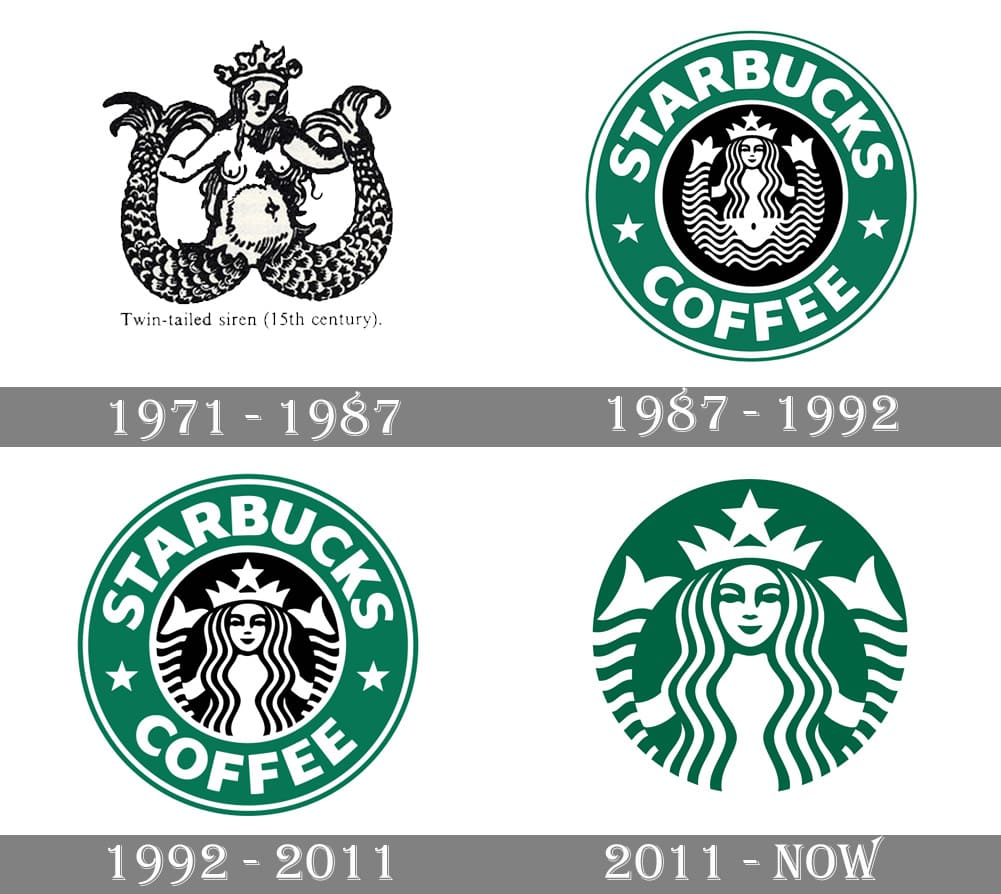
1971 – 1987
Logo #1 of 4 · ~16 saal chala
Logo me kya badla
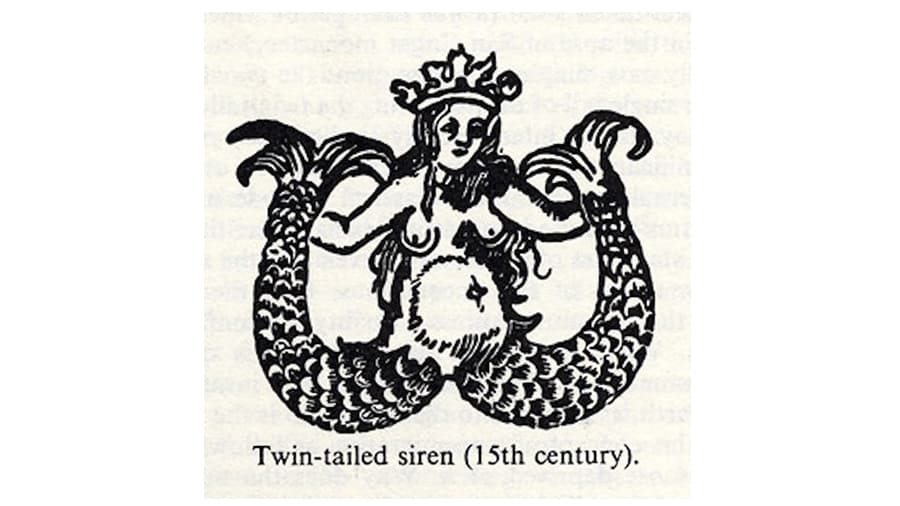
The very first logo of the Starbucks company, designed in 1971, already featured a symbol, which looks pretty close to the current iconic emblem, however, at the same time, has some significant differences. The central element of the logo boasted a a black-and-white drawing of a twin-tailed siren, a mythological creature, which has been known from the 15th century. Its main peculiarity is a tail that is forked into two. The drawing was executed in a pretty detailed yet a bit naive style, resembling an old painting. Placed on a plain white background, the image was accompanied by a capitalized wordmark, written in a pretty simple sans-serif typeface. The upper part of the frame had a “Starbucks” inscription on it, while the bottom one featured “Coffee Tea Spices” in the same font. Both parts of the wordmark were separated by two solid white dots.
Is daur me company me kya hua
1971 – 19876 events
1971
It was founded in 1971 by Jerry Baldwin, Zev Siegl, and Gordon Bowker at Seattle's Pike Place Market initially as a coffee bean wholesaler.
1982
The first Starbucks to sell brewed coffee opened in 1982. 1980s
1984
The company opened its first espresso bar in 1984. 1980s
1985
Since the founders did not wish to expand too far from their original goal of that centered upon selling arabica coffee beans, Schultz left the company in 1985 to found Il Giornale, a cafe inspired by the coffee bars he observed in Milan, Italy. 1980s
1986
By 1986, the company was operating six stores in Seattle and had begun to sell espresso coffee. 1980s
1986
Starbucks was converted into a coffee shop serving espresso-based drinks under the ownership of Howard Schultz, who was chief executive officer from 1986 to 2000 and led the aggressive expansion of the franchise across the West Coast of the United States.
1987 – 1992
Logo #2 of 4 · ~5 saal chala
· pichhle logo ke 16 saal baad
Logo me kya badla
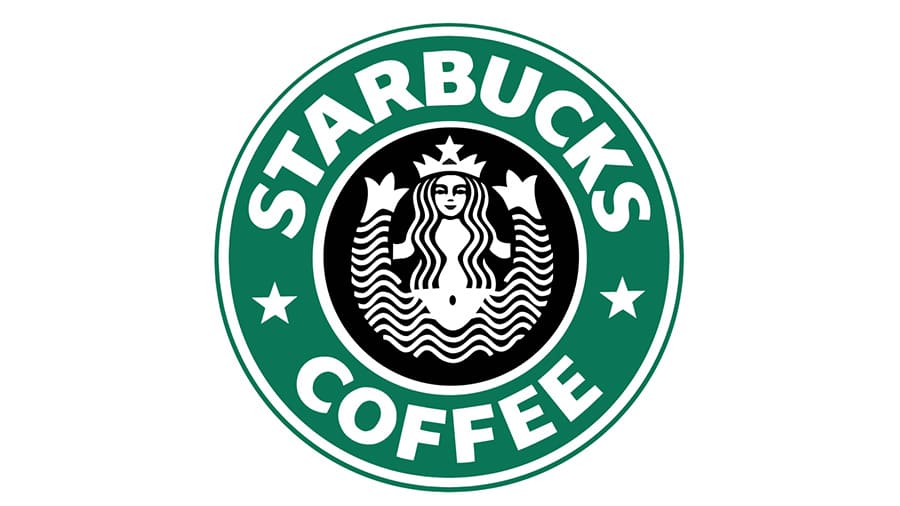
The contours of the badge were refined and modernized in 1987, and the color palette of the badge gained a new hero — green color, which was used for the wide rounded frame of the image of the monochrome siren. The wordmark around the frame was simplified to “Starbucks Coffee”, while its typeface became bolder and the letters — larger. Another thing that was changed — two white dots were replaced by two five-pointed stars, also in white.
Is daur me company me kya hua
1987 – 19926 events
1987
In 1987, the original owners sold the Starbucks chain to Schultz, their former director of marketing, who rebranded his Il Giornale coffee outlets as Starbucks and began to expand the company. 1980s
1987
Also in 1987, Starbucks opened its first locations outside of Seattle, in Waterfront Station in Vancouver, British Columbia, and in Chicago, Illinois. 1980s
1987
The main building in the Starbucks complex in SODO, where the company leases 1.29 million square feet (120,000 m2) of space, was previously a Sears mail order distribution center until 1987. Locations
1987
In the second logo, which was used from 1987 to 1992, the siren's breasts were covered by her flowing hair, but her navel was still visible. Logo
1989
By 1989, there were 46 Starbucks stores located across the Pacific Northwest and Midwest, and the company was roasting more than 2,000,000 pounds (907,185 kg) of coffee annually. 1980s
1990
Hear Music began as a music catalog company in 1990, adding a few retail locations in the San Francisco Bay Area. Hear Music
1992 – 2011
Logo #3 of 4 · ~19 saal chala
· pichhle logo ke 5 saal baad
Logo me kya badla
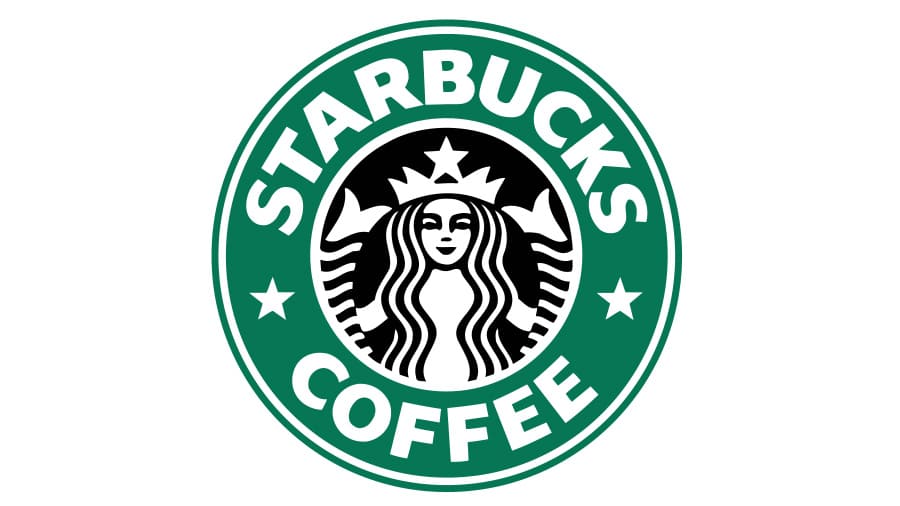
The image of the sirens was enlarged in 1992, and now only the ends of her tails were visible. The typeface was also slightly modernized, making the letters wider and more massive. The logo from these years is probably the most recognizable among all the Starbucks emblems.
Is daur me company me kya hua
1992 – 201183 events
1992
In June 1992, at the time of its initial public offering, Starbucks (ticker symbol: SBUX) had 140 outlets, with revenue of US$73.5 million, up from US$1.3 million in 1987. 1990s
1992
In the third version, used between 1992 and 2011, her navel and breasts are not visible at all, and only vestiges remain of the fish tails. Logo
1994
In 1994, Starbucks acquired The Coffee Connection, gaining the rights to use, make, market, and sell the "Frappuccino" beverage. 1990s
1994
In 1994, Starbucks settled a lawsuit after two employees were dismissed because of their race, age, and sex. Racial controversies
1994
Starbucks began drafting plans for corporate social responsibility in 1994. Farmer equity practices
1995
The beverage was introduced under the Starbucks name in 1995. 1990s
1996
In July 1996, the first Starbucks location opened outside of North America: a store in Tokyo, Japan. Asia
1997
In 1997, Starbucks first offered non-dairy milk at its U.S. stores with the introduction of soy milk. Non-dairy milk offerings
1997
On December 4, 1997, the Philippines became the third market to open outside of North America. Asia
1998
In 1998, Starbucks entered the United Kingdom market with the US$83 million acquisition of the then 56-outlet, UK-based Seattle Coffee Company, re-branding all those stores as Starbucks. Europe
1998
Starbucks and Kraft Foods entered into a partnership in 1998 to sell Starbucks products in the Mondelez grocery stores owned by the latter. Kraft Foods
1998
The first Starbucks store in Malaysia opened in December 1998. Asia
1999
In 1999, Starbucks experimented by opening eateries in the San Francisco Bay Area, under the Circadia restaurant brand. 1990s
1999
Starbucks entered the tea business in 1999 when it acquired the Tazo brand for US$8,100,000. Teavana
1999
In 1999, Starbucks started the "Grounds for your Garden" program. Environmental practices
1999
Hear Music was purchased by Starbucks in 1999. Hear Music
2000
In 2000, Starbucks opened its location in the Forbidden City in Beijing, however, in July 2007, this location was closed after years of controversy since its opening in 2000 with protesters objecting that the presence of the American chain in this location "was trampling on Chinese culture". Asia
2000
In 2000, the company introduced a line of fair trade products. Fair trade
2000
Bowker said, "Moby-Dick didn't have anything to do with Starbucks directly; it was only coincidental that the sound seemed to make sense." The first Starbucks store was located in Seattle, at 2000 Western Avenue, from 1971 to 1976. 1970s
2000
The logo was altered when Starbucks entered the Saudi Arabian market in 2000 to remove the siren, leaving only her crown, as reported in a Pulitzer Prize-winning column by Colbert I. Logo
2000
In July 2000, the first location in Australia opened in Sydney. Australia
2000
The company is ranked 120th on the Fortune 500 and 303rd on the Forbes Global 2000, as of 2022.
2001
Between 2001 and 2003, Starbucks opened six (of 80 planned) locations in Israel and having struggled with fierce local competition, Starbucks, along with its partner Delek, however, in April 2003, after losing US$6 million Starbucks Israel closed all six of its locations in Israel, citing "on-going operational challenges" and a "difficult business environment". Asia
2002
In 2002, it produced a Starbucks opera album, featuring artists such as Luciano Pavarotti, followed in March 2007 by the hit CD Memory Almost Full by Paul McCartney, making McCartney the first artist signed to the new Hear Music label sold in Starbucks outlets. Hear Music
2002
In August 2002, Starbucks provided free Wi-Fi in the United Kingdom, although in the past, a Starbucks rewards card was required. Electricity and Wi-Fi
2002
In October 2002, Starbucks established a coffee trading company in Lausanne, Switzerland, to handle purchases of green coffee. Europe
2003
Ethos water, a brand of bottled water acquired by Starbucks in 2003, is sold at locations throughout North America. Ethos water
2003
By June 2003, Starbucks Japan had 466 stores and would add another 70 to 75 in the 2003 financial year. 2000s
2003
Starbucks in Japan was described by Bloomberg in 2003 as appealing to "New Japan" with its patrons being women in their 20s and 30s who prefer premium coffee and "trendy, no-smoking environment". Asia
2005
Jim Donald was CEO from 2005 to 2008, orchestrating a large-scale earnings expansion. Corporate governance and identity
2005
In addition, Starbucks is an active member of the World Cocoa Foundation, although targets set in 2005, 2008 and 2010 to reduce child labor that the Foundation has backed have consistently not been met. Fair trade
2006
In 2006, Valerie O'Neil, a Starbucks spokeswoman, said that the logo is an image of a "twin-tailed mermaid, or siren as she's known in Greek mythology". Logo
2006
In 2006, Starbucks said it paid $1.42 per pound ($3.1/kg) for its coffee, more than 33% higher than the commodity price at the time. Fair trade
2006
In 2006, the company created Starbucks Entertainment, one of the producers of the 2006 film Akeelah and the Bee. Hear Music
2006
In September 2006, rival Diedrich Coffee announced that it would sell most of its company-owned retail stores to Starbucks, including most locations of Oregon-based Coffee People, escalating regional coffee wars. 2000s
2006
Starbucks began using 10% recycled paper in its beverage cups in 2006—the company claimed that the initiative was the first time that recycled material had been used in a product that came into direct contact with a food or beverage. Recycling
2006
At the beginning of September 2006, and then again in early 2008, Starbucks temporarily reintroduced its original brown logo on paper hot-drink cups. Logo
2006
Of the approximately 300 million pounds (136 million kilograms) of coffee Starbucks purchased in 2006, about 18 million pounds (8.2 million kilograms) or 6% was certified as fair trade. Fair trade
2006
In October 2006, Apple added a Starbucks Entertainment area to the iTunes Store, selling music similar to that played in Starbucks stores. Apple Inc.
2006
Starbucks had drawn similar criticism when it reintroduced the vintage logo in 2006. Logo
2007
In 2007, Starbucks stopped using milk originating from rBGH-treated cows. Non-dairy milk offerings
2007
In September 2007, the company opened its first store in Russia, ten years after first registering a trademark there. Europe
2007
In September 2007, Apple announced that customers would be able to browse the iTunes Store at Starbucks via Wi-Fi in the US—with no requirement to log into the Wi-Fi network—targeted at iPhone, iPod Touch, iPad, and MacBook users. Apple Inc.
2007
This feature was rolled out in Seattle, New York City, and the San Francisco Bay Area, and was offered in limited markets during 2007–2008. Apple Inc.
2007
During the fall of 2007, Starbucks also began to sell digital downloads of certain albums through iTunes. Apple Inc.
2007
Starbucks gave away 37 different songs for free download through iTunes as part of the "Song of the Day" promotion in 2007, and a free "Pick of the Week" download is available from the App Store. Apple Inc.
2007
The March 2007 issue of Consumer Reports compared American fast-food chain coffees and ranked Starbucks behind McDonald's Premium Roast in the middle of a coffee war. Reception
2007
The Equal Employment Opportunity Commission has raised allegations against Starbucks for racial bias in its promotions, allegedly based on workforce data from 2007 to 2011 that showed that minority retail partners in the United States received fewer promotions than statistically expected. Racial controversies
2008
In 2008, Starbucks announced a comprehensive new animal welfare policy banning many inhumane farming practices, including the caging of hens. Cage-free eggs
2008
Schultz returned as CEO during the 2008 financial crisis and spent the succeeding decade growing the company's market share, expanding its offerings, and reorienting the brand around corporate social responsibility. Corporate governance and identity
2008
In 2008, a former African American Starbucks engineer sued the company for discrimination after his supervisor failed to address racist bullying he was experiencing at the workplace, instead giving him extra work due to his complaining. Racial controversies
2008
In July 2008, during the Great Recession, Starbucks announced it was closing 600 underperforming company-owned stores and cutting U.S. expansion plans amid growing economic uncertainty. 2000s
2008
Additionally in July 2008, Starbucks announced that it would close 61 of its 84 stores in Australia in the following month. 2000s
2008
After a massive downturn in 2008, the remaining Australian Starbucks stores were sold to the Withers family in 2014, with the company planning a more restrained expansion. Australia
2008
Both Johnson and Ullman succeeded Howard Schultz, who served in both capacities from 2008 to 2017. Corporate governance and identity
2008
Journalist Jack Schofield noted that "My Starbucks seems to be all sweetness and light at the moment, which I don't think is possible without quite a lot of censorship." In March 2008, Starbucks acquired Coffee Equipment Company, which was the manufacturer of the Clover Brewing System. 2000s
2008
In May 2008, a loyalty program was introduced for registered users of the Starbucks Card (previously simply a gift card) offering perks such as free Wi-Fi Internet access, no charge for soy milk and flavored syrups, and free refills on brewed drip coffee, iced coffee, or tea. Starbucks card and loyalty program
2008
In early 2008, Starbucks started a community website, My Starbucks Idea, designed to collect suggestions and feedback from customers. 2000s
2008
On July 29, 2008, Starbucks also cut almost 1,000 non-retail jobs as part of its bid to re-energize the brand and boost its profit. 2000s
2008
Altogether, from February 2008 to January 2009, Starbucks terminated an estimated 18,400 U.S. jobs and began closing 977 stores worldwide. 2000s
2008
Before the mass-closure of 61 of their 85 stores in 2008, there were also stores in Adelaide, Canberra, Hobart and Wollongong. Australia
2008
In a 2008 media article, Starbucks's vice president of corporate social responsibility acknowledged that the company continued to struggle with environmental responsibility, as none of its cups were recyclable and stores did not have recycling bins. Recycling
2008
Talking to The New York Times in 2008, Howell stated his opinion that the dark roast used by Starbucks does not deepen the flavor of coffee, but instead can destroy purported nuances of flavor. Reception
2008
In January 2008, Starbucks began a "skinny" line of drinks, offering lower-calorie and sugar-free versions of the company's offered drinks that use skim milk, and can be sweetened by a choice of natural sweeteners (such as raw sugar, agave syrup, or honey), artificial sweeteners (such as Sweet'N Low, Splenda, Equal), or one of the company's sugar-free syrup flavors. Low calorie and sugar-free products
2008
In October 2008, The Guardian newspaper reported that Starbucks was wasting 6.2 million U.S. gallons (23.4 million liters) of water a day by leaving a tap constantly running for rinsing utensils in a 'dipper well' in each of its stores, but this is often required by governmental food safety codes. Environmental practices
2009
In 2009, Starbucks began beta testing its mobile app for the Starbucks card, a stored value system in which consumers access pre-paid funds to purchase products at Starbucks. Starbucks card and loyalty program
2009
In 2009, at least three stores in Seattle were de-branded to remove the logo and brand name, and remodel the stores as local coffee houses "inspired by Starbucks". Unbranded stores
2009
In 2009, they established a buying preference in North America to use industry best practices for animal husbandry and processing, including egg production. Cage-free eggs
2009
In August 2009, Ahold announced closures and rebranding for 43 of its licensed store Starbucks kiosks for their US-based Stop & Shop and Giant supermarkets. 2000s
2009
In March 2009, Starbucks introduced a line of instant coffee packets, called VIA "Ready Brew". Instant coffee
2009
Nick Wailes, an expert in strategic management of the University of Sydney, said that "Starbucks failed to truly understand Australia's café culture." In January 2009, Starbucks announced the closure of an additional 300 underperforming stores and the elimination of 7,000 positions. 2000s
2009
The first two VIA flavors include Italian Roast and Colombia, which were then rolled out in October 2009, across the U.S. and Canada with Starbucks stores promoting the product with a blind "taste challenge" of the instant versus fresh roast, in which many people could not tell the difference between the instant and freshly brewed coffee. Instant coffee
2009
In June 2009, in response to concerns over its excessive water consumption, Starbucks re-evaluated its use of the dipper well system. Environmental practices
2009
In September 2009, company-operated Starbucks stores in Canada and the United States successfully implemented a new water saving solution that meets government health standards. Environmental practices
2009
Starting on June 1, 2009, the MSNBC morning news program Morning Joe has been presented as "brewed by Starbucks" and the show's logo changed to include the company logo. MSNBC
2010
In 2010, the company began its Starbucks Reserve program for single-origin coffees and high-end coffee shops. Locations
2010
In 2010, Starbucks began selling alcoholic beverages at some stores in the United States. Alcoholic drinks
2010
In December 2010, Starbucks debuted their first-ever Starbucks at sea. At sea
2010
The agreement was partially reached so Starbucks coffees could be served in the country in time for the 2010 FIFA World Cup hosted by South Africa. Africa
2010
Since 2010, Starbucks has been donating leftover pastries in the United States to local food banks through a food collection service named Food Donation Connection. Food bank donations
2010
As reported by Time in 2010, third wave coffee proponents generally criticize Starbucks for over-roasting beans. Reception
2010
As a result, Starbucks retrained its baristas and changed its roasting methods in 2010 to "standardize quality over quantity". Reception
2010
On July 1, 2010, Starbucks offered free Wi-Fi in all of its stores in the U.S. and Canada. Electricity and Wi-Fi
2011 – Today
Logo #4 of 4 · ~15 saal chala
· pichhle logo ke 19 saal baad
Logo me kya badla
In 2011 the Starbucks logo has undergone another redesign, and the emblem we all can see today is a simplified yet brightened version of the previous badges. Now it is composed of a white siren’s image placed on a solid green background color without any framing or lettering around it. The siren repeats the contours of the previous badge but looks a bit different due to the new color combination and absence of black details. Why is there a mermaid on the Starbucks logo? The Mermaid, or Siren, has been on the Starbucks logo since the very beginning. The original version of the emblem was designed by Terry Heckler, who got his inspiration from Moby-Duck and the nautical theme, as the name of the brand was taken from the famous novel by Henry Melville.
Is daur me company me kya hua
2011 – Today177 events
2011
On November 10, 2011, Starbucks acquired juice company Evolution Fresh for US$30 million in cash and planned to start a chain of juice bars starting in around the middle of 2012, venturing into territory staked out by Jamba Inc. Fruit juices, fruit beverages, and sodas
2011
In January 2011, Starbucks and Tata Coffee, Asia's largest coffee plantation company, announced plans for a strategic alliance to bring Starbucks to India and also to source and roast coffee beans at Tata Coffee's Kodagu facility. Asia
2011
In January 2011, Starbucks introduced its largest cup size, the Trenta, which can hold 31 US fluid ounces (920 ml). Asia
2011
In October 2011, Starbucks opened another location in Beijing, China, at the Beijing Capital International Airport's Terminal 3, international departures hall; making the company's 500th store in China. Asia
2011
In January 2011, Starbucks announced that it would make small changes to the company's logo, removing the Starbucks wordmark around the siren, enlarging the siren image, and making it green. Logo
2011
In February 2011, Starbucks started selling its coffee in Norway by supplying Norwegian food shops with their roasts. Europe
2011
Starbucks released its complete mobile platform in January 2011. Starbucks card and loyalty program
2011
By December 2011, the number of mobile transactions exceeded 26 million. Starbucks card and loyalty program
2012
In 2012, Starbucks had annual Frappuccino sales of over US$2 billion. 2010s
2012
In September 2012, Starbucks announced plans to introduce the Verismo, a consumer-grade single-serve coffee machine that uses sealed plastic cups of coffee grounds, and a "milk pod" for lattes. Coffee makers and single-use capsules
2012
In October 2012, Starbucks and Duracell Powermat announced a pilot program to install Powermat charging surfaces in the tabletops in selected Starbucks stores in the Boston area. Electricity and Wi-Fi
2012
In May 2012, Starbucks opened its first coffeehouse in Finland, with the location being Helsinki-Vantaa Airport in Vantaa. Europe
2012
In October 2012, Starbucks announced plans to open 1,000 stores in the United States in the next five years. Americas
2012
Starbucks opened its first store in India in Mumbai on October 19, 2012. Asia
2012
In March 2012, Starbucks began selling a line of iced Starbucks Refresher beverages that contain a green coffee extract. Fruit juices, fruit beverages, and sodas
2012
In January 2012, despite a false start in 2007, Starbucks created a 50:50 joint venture with Tata Global Beverages called Tata Starbucks. Asia
2012
Organizations such as World Animal Protection and Compassion in World Farming have stated that Starbucks has not shown any demonstrable improvement in animal welfare since 2012. Cage-free eggs
2012
In November 2012, Starbucks Verismo became publicly available, consisting of a line of coffee makers that brew espresso and regular chocolate from coffee capsules, a type of pre-apportioned single-use container of ground coffee and flavourings utilizing the K-Fee pod system. Coffee makers and single-use capsules
2013
The company once again utilized the mobile platform when it launched the "Tweet-a-Coffee" promotion in October 2013. 2010s
2013
Its first store released in San Bernardino, California and plans for a store in San Francisco were to be launched in early 2013. Fruit juices, fruit beverages, and sodas
2013
In 2013, it switched providers in the U.S. from AT&T to Google. Electricity and Wi-Fi
2013
In August 2013, the first Starbucks inside Dansk Supermarked opened in the department stores Salling in Aalborg and Aarhus in Denmark. Europe
2013
In April 2013, Starbucks introduced reusable cups where customers would be able to bring their cup into any location and receive a small discount on their drink. Reusable cups
2013
On June 25, 2013, Starbucks began to post calorie counts on menus for drinks and pastries in all of its U.S. stores. 2010s
2013
In July 2013, more than 10% of in-store purchases were made on customers' mobile devices via the Starbucks app. 2010s
2013
Research firm Keyhole monitored the progress of the campaign; a December 2013 media article reported that 27,000 people had participated and US$180,000 of purchases had been made to date. 2010s
2013
In mid-November 2013, an arbitrator ordered Starbucks to pay a fine of US$2.8 billion to Mondelez International, a corporate spin-off of Kraft, for its premature unilateral termination of the agreement. Kraft Foods
2013
As of 2013, the Starbucks website sells only one Ethiopian coffee. Fair trade
2014
In 2014, a Milwaukee Starbucks employee called the police when they noticed a black man sleeping in a park, which resulted in the police officer killing the man by shooting him 14 times, prompting protests. Racial controversies
2014
In May 2014, Starbucks announced ongoing losses in the Australian market, which resulted in all remaining stores being sold to the Withers Group. 2010s
2014
In August 2014, Starbucks opened its first store in Williamsburg, Brooklyn which by then was among 30 locations serving beer and wine. Alcoholic drinks
2014
In November 2014, Starbucks announced its first Channel Island store, in the primary business area of St Peter Port in Guernsey. Europe
2014
In May 2014, the Starbucks operations in South Korea launched a mobile ordering system named Siren Order, accessible through a local version of the Starbucks smartphone application. Asia
2014
In September 2014, Starbucks announced the acquisition of the remaining 60.5% stake in Starbucks Coffee Japan that it did not already own, for US$913.5 million. Asia
2014
The first café was set to open in 2014 in Bogotá and add 50 more stores throughout Colombia's main cities in a 5-year limit. Americas
2014
In June 2014, Starbucks announced a partnership with Arizona State University (ASU) that would allow Starbucks employees in their Junior and Senior years of college to complete four years of college at Arizona State University's online program for only around US$23,000. Arizona State University
2014
In January 2014, as part of a change in compact direction, Starbucks management transitioned from a singular brand worldwide to focusing on locally relevant design for each store. 2010s
2014
In June 2014, Starbucks began trialing its own line of carbonated sodas, dubbed "Fizzio". Fruit juices, fruit beverages, and sodas
2015
Kevin Johnson, who was president and chief operating officer from 2015 to 2018, succeeded Schultz as CEO in 2017. Corporate governance and identity
2015
In October 2015, Starbucks hired its first chief technology officer, Gerri Martin-Flickinger, to lead its technology team. Corporate governance and identity
2015
In 2015, Starbucks made a public announcement that they would switch to 100% cage-free eggs by 2020. Cage-free eggs
2015
In 2015, Starbucks signed a deal with PepsiCo to market and distribute Starbucks products in several Latin American countries. PepsiCo
2015
On April 21, 2015, Kesko, the second largest retailer in Finland, announced its partnership with Starbucks, with stores opened next to K-Citymarket hypermarkets. Europe
2015
The expanded nationwide in 2015, and in late March 2018, the company opened the system, previously available to Starbucks Rewards members only, to all customers. Asia
2015
In August 2015, Starbucks announced plans to open in Phnom Penh, Cambodia, its 16th market in the China/Asia Pacific region by the end of 2015. Asia
2015
In May 2015, Starbucks entered a partnership with music streaming service Spotify. Spotify
2015
In January 2015, Starbucks began to roll out Teavana teas into Starbucks stores, both in to-go beverage and retail formats. Teavana
2015
The 2015 Starbucks "Race Together" campaign, when baristas were instructed to write the phrase "Race Together" on customer's cups with the aim to start a national dialogue about race, was heavily criticized and received backlash. Racial controversies
2016
In 2016, three locations within Toronto, Ontario also announced they were going to serve alcohol, including up-scale appetizers like bacon-wrapped dates and truffle mac and cheese. Alcoholic drinks
2016
In August 2016, startup company FluxPort introduced Qi inductive charging pads at select locations in Germany. Electricity and Wi-Fi
2016
By 2016, there were more than 500 locations in Mexico. Americas
2016
In January 2016, Starbucks announced that it would launch operation in Trinidad and Tobago. Americas
2016
In April 2016, after TASTE Holdings acquired outlet licensing for South African stores, Starbucks opened its first stores in South Africa in Rosebank, Gauteng, Johannesburg and the Mall of Africa. Africa
2016
In September 2016, Starbucks announced a debut of its first-ever original content series called "Upstanders", which aimed to be inspirational. Upstanders
2016
In February 2016, Howard Schultz announced the opening of stores in Italy. Europe
2016
In May 2016, the first Starbucks store in Slovakia opened in Aupark, in Bratislava. Europe
2016
In March 2016, Starbucks unveiled a five-year plan to donate 100 percent of unsold food from its 7,600 company-operated stores in the U.S. to local food banks and pantries. Food bank donations
2017
In March 2017, Starbucks announced the launch of two new limited-edition specialty drinks made from beans aged in whiskey barrels at its Seattle roastery. Barrel-aged coffee
2017
As of June 2017, three stores had been opened next to K-Citymarkets: In Sello in Espoo and in Myyrmanni and Jumbo in Vantaa. Europe
2017
In December 2017, the Starbucks Reserve Roastery opened at HKRI Taikoo Hui in Shanghai, China, the only such location of its kind outside of Seattle. Asia
2017
In November 2017, Starbucks commenced operations in Jamaica, where the first store opened in the resort city of Montego Bay on the shores of the Doctor's Cave Beach Club, offering views of the Caribbean Sea. Americas
2017
Starbucks Jamaica opened its first store on November 21, 2017, with plans to open 15 locations island-wide over a 5-year period. Americas
2017
It planned to open 1,000 Reserve coffee shops by the end of 2017. Locations
2017
As of 2017, the program was in 10 different markets, including New York City. Food bank donations
2018
Ullman became chairman of the firm in June 2018. Corporate governance and identity
2018
Since 2018, Schultz has served as the firm's first Chairman emeritus. Corporate governance and identity
2018
In 2018, Starbucks committed to reaching the goal of using 100% cage-free eggs and egg products in company-operated stores globally by 2020, including Starbucks branded products and those supplied to licensed partners in the North America. Cage-free eggs
2018
In 2018, Business Insider conducted a test of Starbucks coffee judged by 100 coffee experts. Reception
2018
In 2018, two black men were arrested and escorted out of a Philadelphia Starbucks after the staff called the police because they refused to leave. Racial controversies
2018
On March 21, 2018, Starbucks announced that it was considering the use of blockchain technology to connect coffee drinkers with coffee farmers who could eventually be able to take advantage of new financial opportunities. 2010s
2018
On June 19, 2018, Starbucks announced the closing of 150 locations in 2019, three times the number the corporation typically closes in a single year. 2010s
2018
The first Italian Starbucks store was inaugurated in Milan on September 6, 2018, at which point Starbucks already had locations in 78 countries. Europe
2018
In December 2018, Starbucks expanded its partnership with Uber Eats to bring its beverages to U.S. customers' doorsteps, as it had already done for some time in China. Uber Eats
2018
Niccol had served as the CEO of Chipotle since 2018. 2020s
2018
In June 2018, Starbucks announced the opening of stores in Serbia. Europe
2018
The first of the Kingston stores opened on June 21, 2018. Americas
2018
On July 9, 2018, Starbucks President and CEO Kevin Johnson announced that Starbucks would phase out the single-use plastic straws by January 1, 2020, on all cold drinks from all locations worldwide due to climate change concerns, pollution, and sea turtle endangerment as the single-use plastic straws failed to be designed for recycling when they were invented. Phase out of single-use plastic straws
2018
Two men were arrested in a Philadelphia Starbucks location after a manager claimed the two were trespassing on April 12, 2018. 2010s
2018
On April 11, 2018, Starbucks began operations in Uruguay, with a location in the Montevideo Shopping mall. Americas
2018
Individual Starbucks cafes have faced criticism over incidents of racial bias, leading the company to close 8,000 cafes for a day in 2018 for racial bias training. Racial controversies
2018
In another 2018 incident, a black man was denied the code for the restroom for not being a customer, even though at the same time a white man was given that code before ordering anything. Racial controversies
2018
The court found that Starbucks fired her in 2018 because she was white. 2020s
2019
In 2019, at the Microsoft Build conference, the coffee company formally announced its "bean to cup" program using the Microsoft's Azure-based blockchain service. 2010s
2019
In July 2019, Starbucks announced that it would no longer be selling newspapers in its cafés. 2010s
2019
It was also announced that kiosks for grab-and-go snacks and bags of whole-bean coffee would be removed from stores beginning in September 2019. 2010s
2019
In November 2019, Starbucks opened its largest store ever on Michigan Avenue, Chicago, with 200 employees. 2010s
2019
On June 1, 2019, Starbucks opened its first coffee store in Valletta, Malta, the 80th country to have a Starbucks outlet. Europe
2019
When the COVID-19 pandemic first began in 2019, the company halted the use of personal cups due to concerns with the transferring of germs. Reusable cups
2019
In 2019, the non-profit labor justice organization Fair World Project released an article outling how despite Starbucks had passed coffee producers as slave free in their Brazil production units using their internal C.A.F.E. certification standards, that Brazilian labor inspectors had proof of child slave labor practices being present in their supply chain. Fair trade
2019
The first store was opened in April 2019 at Rajiceva Mall. Europe
2019
Starbucks Jamaica announced plans to open up to six stores in Kingston, Jamaica, by 2019. Americas
2019
In August 2019, a franchised location opened in the Cayman Islands. Americas
2019
In October 2019, a franchised location opened in the Turks and Caicos Islands. Americas
2020
In 2020, employees were prohibited from wearing Black Lives Matter symbols or phrases on their clothing or accessories. Racial controversies
2020
In December 2020, Starbucks announced that it is planning to increase its store count to about 55,000 by 2030, up from roughly 33,000. 2020s
2020
CEO Kevin Johnson said in a 2020 interview that, milk substitutes would be a big part of reducing carbon emissions. Non-dairy milk offerings
2020
In December 2020, Starbucks announced it would offer Oatly oat milk in all US stores starting in spring 2021. Non-dairy milk offerings
2020
In March 2020, Starbucks announced that starting from April 6, all U.S. employees and their eligible family members could use up to 20 free mental health therapy or coaching sessions per year. Lyra Health Inc.
2020
In June 2020, during the COVID-19 pandemic in the United States, the company announced that it would close 400 of its locations in the US/Canada region over the subsequent 18 months as it moves from the coffee house concept to "convenience-led" formats with drive-through and curbside pickup. 2020s
2020
In November 2020, Starbucks announced that it plans to open an outlet in Laos. Asia
2020
On March 20, 2020, due to the COVID-19 pandemic, Starbucks closed all the café-only stores in the United States for two weeks. 2020s
2020
In May 2020, the company asked for reduced rent from landlords due to the decrease in sales. 2020s
2020
As of December 31, 2020, Starbucks has discontinued producing their own K-Fee pods for Verismo machines, however, third-party companies continue to produce coffee pods for K-Fee machines, of which the Starbucks Verismo is compatible. Coffee makers and single-use capsules
2020
In January 2020, Starbucks shared its new environmental sustainability commitment to become a resource positive company. Environmental practices
2020
After successfully completing the campaign to provide the Reusable Cup in Vietnam in 2020, it held the same event in Korea in 2021. Reusable cups
2020
In January 2020, oat milk became available nationally. Non-dairy milk offerings
2021
In 2021, a Starbucks in Ireland was fined €12,000 after an Irish Thai customer received her order with a racist drawing on the cup. Racial controversies
2021
Finally, on December 9, 2021, the workers at the Elmwood Avenue store became the first unionized Starbucks workers at a Starbucks owned location in the United States with a 19–8 vote. American unionization efforts
2021
There are over 9,000 American locations, but since the first unionized location in New York in 2021, less than 3% have voted to unionize. American unionization efforts
2021
In the 2021 film Ghostbusters: Afterlife, it is stated by Ray Stantz (Dan Aykroyd) that Starbucks had taken over the Ghostbusters' firehouse headquarters at North Moore Street after they went out of business and had turned it into a coffeehouse before Winston Zeddemore (Ernie Hudson) bought it back from them. Films
2021
Three of the company's stores in Buffalo, New York began an attempt to unionize in August 2021. American unionization efforts
2021
Inspired by their colleagues in Buffalo, workers at a Starbucks store in Mesa, Arizona, petitioned the NLRB for a union election on November 18, 2021, to be represented by Workers United. American unionization efforts
2021
In June 2021, the company reintroduced personal reusable cups with a contactless new method to eliminate shared touch points between customers and baristas. Reusable cups
2022
In 2022 Starbucks announced that they were going to stop certifying their coffee beans as fairtrade, in favor of their own in-house investigations. Fair trade
2022
In March 2022, Starbucks announced that Schultz would return as CEO in April 2022 in an interim role. Corporate governance and identity
2022
In 2022, over a period of several months, Starbucks terminated more than 85 U.S. workers who had been involved in union organizing. Union busting
2022
In August 2022, after months of suspension due to the Russian invasion of Ukraine, Starbucks sold all its stores in Russia to the Russian rapper Timati. 2020s
2022
He was succeeded by Orin Smith, who ran the company for five years and positioned Starbucks as a large player in fair trade coffee (fair trade later being overturned during Kevin Johnson's leadership in 2022), increasing sales to US$5 billion. Corporate governance and identity
2022
On March 4, 2022, then-CEO Kevin Johnson condemned the invasion and stated that Starbucks would donate the royalties it received from its Russian operations to humanitarian relief efforts in Ukraine. Response to Russian invasion of Ukraine
2022
In May 2022, Starbucks announced that it would permanently leave the Russian market and close its 130 licensed stores there. Response to Russian invasion of Ukraine
2022
In November 2022, the company announced the closure of a Seattle location that had been the first Starbucks store to unionize in the city, citing safety concerns. Union busting
2022
In January 2022, Starbucks launched a line of canned energy drinks, called "Baya". Functional beverages
2022
After the Russian invasion of Ukraine, on May 21, 2022, Starbucks announced closure of all outlets in Russia, and in July it was revealed that a local restaurant manager, Anton Pinsky, is going to acquire Starbucks' Russian operating company OOO Starbucks and all its 130 stores. Europe
2022
The first drive-thru store opened in 2022 at Porto Chino community mall on Rama II Road. Asia
2022
As of November 2022, the company had 35,711 stores in 80 countries, 15,873 of which were located in the United States.
2022
Bloomberg reported in July 2022 that the company was, through investment bank Houlihan Lokey, exploring selling its stores in the United Kingdom. 2020s
2022
In February 2022, Starbucks fired seven workers in Memphis who had led the unionization effort and temporarily closed the store. American unionization efforts
2022
In August 2022, the National Labor Relations Board accused the company of illegally discriminating against unionized workers by refusing them wage and benefit increases and requesting restitution. American unionization efforts
2022
On November 17, 2022, Starbucks’ annual Red Cup Day and one of the busiest days for employees, over 100 locations had employees go on strike. American unionization efforts
2022
Following the 2022 Russian invasion of Ukraine, Starbucks initially faced criticism for continuing to operate in Russia. Response to Russian invasion of Ukraine
2023
In December 2023, the operator of all of the Starbucks locations in Brazil, SouthRock Capital, declared itself bankrupt. 2020s
2023
In February 2023, Starbucks announced it would introduce a line of coffee drinks made with extra virgin olive oil, including lattes, shaken espresso, and cold brews. Oleato coffee
2023
The drinks were initially available in Italy and later expanded to stores in Southern California in spring 2023 and then the UK, Middle East, and Japan later the same year. Oleato coffee
2023
Later that September, Laxman Narasimhan was appointed to succeed him in April 2023, with Schultz remaining a member of the board of directors. Corporate governance and identity
2023
Narasimhan assumed the position sooner than planned, in March 2023. Corporate governance and identity
2023
On March 23, 2023, Narasimhan told employees that he would work a half-day behind a store counter each month, and he trained as a barista to immerse himself in the brand and stay close to customers. 2020s
2023
In June 2023, Starbucks was ordered to pay $25 million in punitive damages and $600,000 compensatory damages to a former regional manager. 2020s
2023
By March 2023, the NLRB found no merit in Starbucks's complaints and instead ruled that it was Starbucks who refused to bargain. American unionization efforts
2023
On June 23, 2023, Starbucks workers at unionized stores went on strike over the company's stance on in-store LGBT pride decorations. American unionization efforts
2023
The company's headquarters is the Starbucks Center in Seattle, Washington, United States, where 3,750 people worked as of 2023. Locations
2023
As of February 2023, Starbucks had 36,171 locations open across 83 countries, with 61% of the locations operating in the U.S. and China, and the rest operating elsewhere. Locations
2023
In June 2023, Starbucks attracted controversy for allegedly not allowing workers at some locations in 22 states to put up Pride Month decorations. Pride/LGBTQ+
2023
In late 2023, Starbucks faced boycotts by the Boycott, Divestment and Sanctions movement following the company's decision to sue the Starbucks Workers United (SWU) union for making a social media post stating "Solidarity with Palestine" shortly after the October 7 Hamas-led attack on Israel. Boycott amidst the 2023 Gaza war
2024
In 2024, a shareholder proposal called for greater disclosure of the company's human rights risks and dependence on China, citing concerns about the country's human rights record. Other controversies
2024
In August 2024, he was ousted and replaced with Brian Niccol, who became the chain's CEO on September 9 after leaving his position as Chipotle's CEO. Corporate governance and identity
2024
In June 2024, Starbucks introduced Iced Energy, a fruit-flavored energy drink, at its US locations. Functional beverages
2024
On April 29, 2024, Starbucks announced its official entry to Ecuador and Honduras in mid-year and late 2024, respectively. Americas
2024
On August 14, 2024, Starbucks commenced operations in Ecuador, with its first location in the country at Scala Shopping Mall in Quito. Americas
2024
However, there are plans to open a restaurant in Toowoomba while the first store in Perth, Western Australia opened on October 23, 2024, with another 11 planned to open by the end of 2025. Australia
2024
With the launch of their holiday menu in November 2024, Starbucks ended the upcharge for non-dairy milk additions to drinks. Non-dairy milk offerings
2024
In January 2024, the company said it would introduce the beverages nationwide in the US as well as in Canada, France, and China. Oleato coffee
2024
In December 2024, workers at more than 300 U.S. stores went on strike during the holiday season over stalled contract negotiations concerning wages, staffing, and working conditions. Union busting
2024
We stand for humanity." In 2024, the boycott had had a negative impact on sales, resulting in a 2% decline in North America and a 7% decline worldwide. Boycott amidst the 2023 Gaza war
2024
The Oleato beverages were permanently discontinued in November 2024. Oleato coffee
2024
In February 2024, the chain unveiled a new store design aimed at improving accessibility. Locations
2025
In 2025, a court ordered Starbucks to pay $50 million to a driver who suffered burns after an unsecured hot drink spilled on him. Other controversies
2025
In July 2025, Starbucks announced corporate office employees would have to return to working physically in the office four days per week, starting in October. 2020s
2025
The company announced the plans of opening four more cafes in the capital city until the end of 2025. Americas
2025
A canned version was introduced in March 2025. Functional beverages
2025
In July 2025, Starbucks opened its first store in Iceland. Europe
2025
In January 2025, Starbucks ended its 'open-door policy', and requires customers to make a purchase in order to use restrooms and the seating area. 2020s
2025
In February 2025, Starbucks cut 30% of its menu in an effort to simplify its processes and reduce costs. 2020s
2025
In January 2025, Starbucks and Workers United agreed to use a mediator to help resume stalled negotiations. Union busting
2025
In November 2025, more than 1,000 unionized Starbucks workers in more than 40 U.S. cities began an open-ended strike over stalled contract negotiations. Union busting
2025
On Red Cup Day 2025, Starbucks employees organized a walkout at 4 p.m. local time in over a dozen U.S. cities as part of a strike known as the Red Cup Riot, involving approximately 1,000 baristas. Other controversies
2025
In June 2025, Starbucks began testing a protein-infused foam topping. Functional beverages
2025
Starbucks is phasing out disposable cups in Korea entirely by 2025. Reusable cups
2026
In 2026, Starbucks announced the long-term lease of 250,000 square feet (23,000 m2) for a regional office in Nashville, Tennessee. Locations
2026
In January 2026, Starbucks announced their turnaround strategy which involved forming a joint venture with Boyu Capital to run its business in China, the company’s second-largest market. 2020s
2026
In March 2026, Starbucks announced plans for new regional corporate offices, making a massive expansion by establishing a major corporate hub in Nashville, Tennessee. 2020s
2026
In July 2026, Starbucks opened its first location in Guayaquil, and now has 10 stores across the country. Americas
2026
In 2026, a study published by Beyond Plastics, an environmental watchdog group, found that none of the 53 polypropylene plastic cups deposited in recycling bins at Starbucks stores across 9 US states and the District of Columbia with Bluetooth trackers attached ended up at a recycling facility, despite the cups being touted by Starbucks as "widely recyclable." Recycling
2026
In 2026, Starbucks Korea, which is operated by the Shinsegae Group in South Korea, released a promotion for "Tank Day" coffee tumblers, which was criticized for evoking memories of the Gwangju Uprising in 1980 and the 1987 death by torture of student activist Park Jong-chul, leading to nationwide boycotts and protests. Other controversies
2026
As of January 2026, the brand has opened over 150 stores in the country. Asia
2026
In October 2026, Starbucks opened its first store in Xinjiang, China, located in Ürümqi. Asia
2026
After the deal closes in the second quarter of fiscal 2026, pending regulatory approval, Boyu will hold up to a 60% interest in the joint venture. 2020s
2026
Union organizing and collective bargaining continued into 2026, with Workers United winning representation elections at additional Starbucks locations and new organizing petitions being filed with the National Labor Relations Board. Union busting
Saare logos ek saath
Design details
Emblem and conspiracy theories
As with any other significant event or symbol, there are many rumors about the Starbucks logo. Even though the company’s management has repeatedly stated that the Siren on their logo was inspired by historical engravings and reflects only the global origin of the beans and the incredible appeal of the brand’s coffee, many fans of mysteries and conspiracies build their theories. For example, according to the full version, the Siren is an inverted Satanic symbol, the Goat’s Head. The location of the star on the Mermaid’s head some also connect to Illuminati, as since 2011 is located on a place of the all-seeing eye. And one more theory is connected to Zionists, as according to some, the Starbucks mermaid is a depiction of Queen Esther.
Symbol
For the most part of the history, the official color palette of the Starbucks logo was composed of three shades: green, white and black. However, as any other large brand, Starbucks needed a change, and this change was made in 2011 by removing the black from the composition. So today the official color scheme of the brand consists of solely green and white. The forest-like shade of green is already known all over the globe as the Starbucks green, looking very elegant, calm and chic.
Font
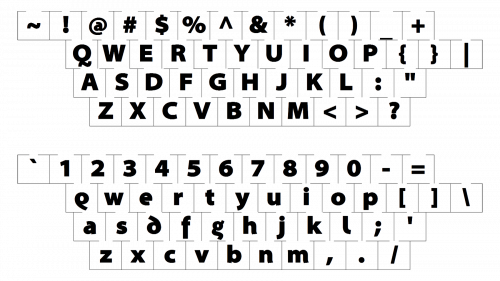
In its logo, Starbucks has used the Freight Sans font. It is quite in keeping with the Starbucks logo design trend, which is observable in all its logo versions. What is the meaning behind the Starbucks logo? The iconic green and white Starbucks badge feature an image of a mermaid, which not only makes the badge of the brand stand out but also “evokes coffee’s allure and its seafaring tradition”, according to the company. The Mermaid also explains the name of the company, which was taken from “Moby Dick”, supporting the sea theme. Who is the Queen on the Starbucks logo? The lady on the logo of the famous coffee house chain depicts a Mermaid in the crown. So we can call her the Queen of the Sea. Is the Starbucks logo a mermaid? Yes, the iconic Starbucks logo is a Mermaid. An elegant and stylish picture supports the origins of the company’s name, Starbucks, which was adopted from one of t…