LogoTimeline

Zoom

4 logo version 3 baar badla 2011 se shuru 15 saal ka safar sabse lamba chala 2014 – 2022 35 events 12 saal me events mile

Zoom is a cloud-based video conferencing tool provided by Zoom Video Communications, Inc., a US company based in California. It was founded in 2011, but the software was introduced only in 2013. Starting from 2020, the software experienced a dramatic global increase due to the COVID-19 pandemic. Today, when many brands would leap from one logo to another, Zoom cannot be criticized as a company with a fluid visual brand identity. The design remained the same for at least the first decade of the brand’s existence. What is Zoom Zoom Cloud Meetings is one of the world’s most popular cloud platforms for video and audio conferencing, chat, and webinars. It is best known for HD video chat and conferencing. While many users opt for the free plan, there are also paid plans offering up to a thousand concurrent participants and a 30-hour time restriction.

Logo timeline  ·  kisi bhi logo par click karo

Zoom logo 2011 – 2013

2011 – 2013

Logo #1 of 4  ·  ~2 saal chala

Logo me kya badla

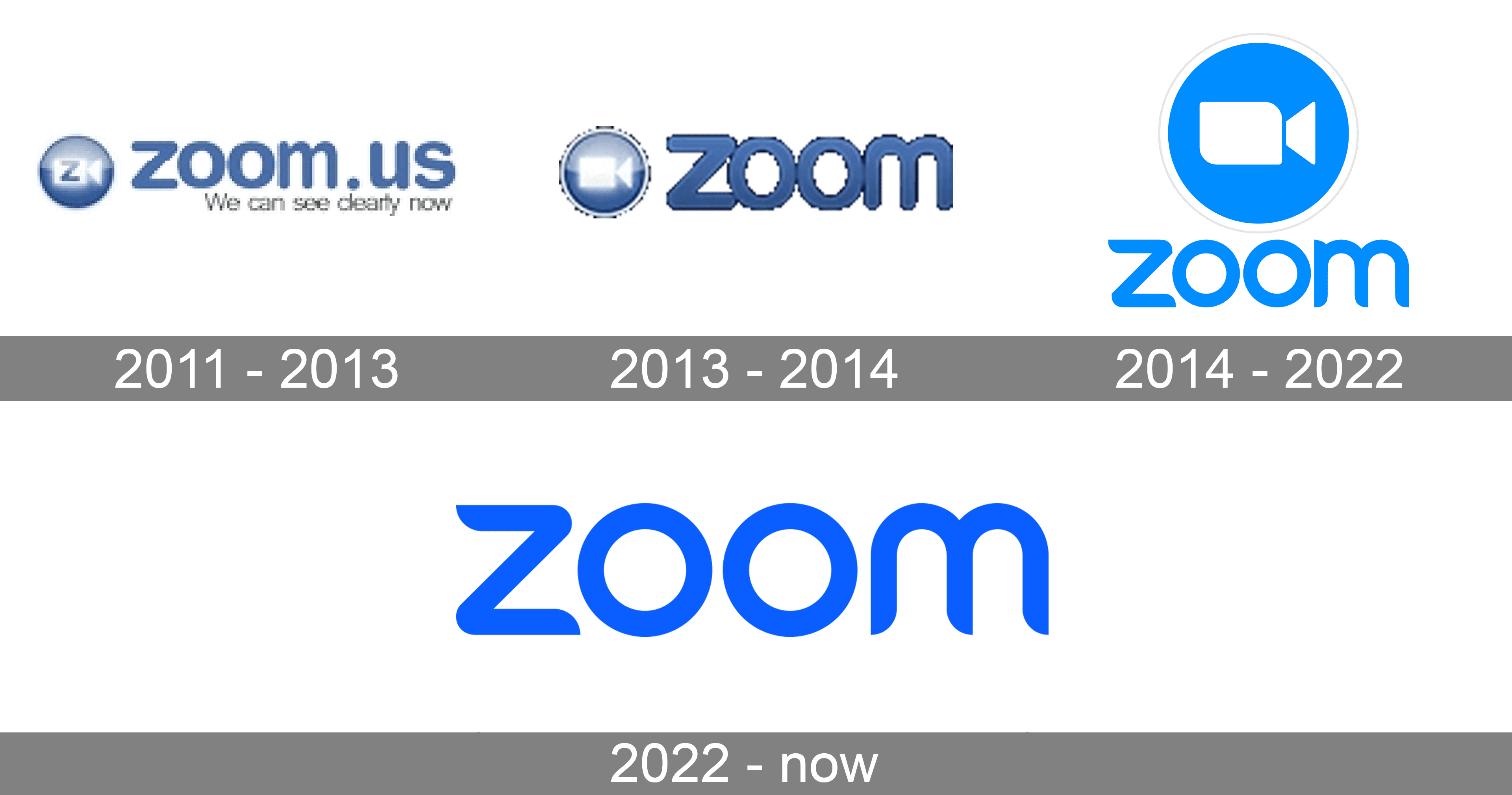
The very first logo of the Zoom software was created in 2011 and stayed untouched for more than two years. It was a very confident for its time, yet simple and calm badge, composed of a circular emblem and lowercase lettering, executed in a smooth muted shade of blue and white. The emblem of the platform featured a stylized minimalistic image of a camera side view with the blue letter “Z” Drawn on it. The white camera was placed inside a solid blue circle.

Is daur me company me kya hua 2011 – 2013 6 events

1989
The charges are related to the alleged disruptions to video meetings commemorating the 1989 Tiananmen Square protests and massacre. Privacy and security issues
2011
He left Cisco in April 2011 with 40 engineers to start a new company, originally named Saasbee, Inc. Early years
2011
The company was founded in 2011 by Eric Yuan, a former Cisco engineer and executive.
2012
In September 2012, Zoom launched a beta version that could host conferences with up to 15 video participants. Early years
2012
In November 2012, the company signed Stanford University as its first customer. Early years
2012
In May 2012, the company changed its name to Zoom, influenced by Thacher Hurd's children's book Zoom City. Early years
Zoom logo 2013 – 2014

2013 – 2014

Logo #2 of 4  ·  ~1 saal chala  ·  pichhle logo ke 2 saal baad

Logo me kya badla

The redesign of 2013 has simplified the original concept of the Zoom logo, deleting the “.us” part of the inscription, and removing the blue letter “Z” from the emblem. As for other changes, made to the Zoom badge, they include the darkening of the shade of blue, and the refinement of the emblem, with the typeface of the inscription, also changed. All the details became bolder and brighter now.

Is daur me company me kya hua 2013 – 2014 3 events

2013
By the end of its first month, Zoom had 400,000 users and by May 2013 it had 1 million users. Early years
2013
In July 2013, Zoom established partnerships with B2B collaboration software providers, such as Redbooth (then Teambox), and also created a program named Works with Zoom, which established partnerships with Logitech, Vaddio, and InFocus. Growth
2013
In September 2013, the company raised $6.5 million in a Series B round from Horizon Ventures, and existing investors. Growth
Zoom logo 2014 – 2022

2014 – 2022

Logo #3 of 4  ·  ~8 saal chala  ·  pichhle logo ke 1 saal baad

Logo me kya badla

The main Zoom logo is just the wordmark. There is also an icon, which can be used independently. In addition to these, there is also a full version, where the wordmark is paired with the emblem, which looks almost exactly like the icon but has a slightly different shape.

Is daur me company me kya hua 2014 – 2022 23 events

2015
In November 2015, former president of RingCentral David Berman was named president of the company, and Peter Gassner, the founder and CEO of Veeva Systems, joined Zoom's board of directors. Growth
2015
Over the course of 2015 and 2016, the company integrated its software with Slack, Salesforce, and Skype for Business. Growth
2015
With version 2.5 in October 2015, Zoom increased the maximum number of participants allowed per conference to 50 and later to 1,000 for business customers. Growth
2016
The FTC alleged that since at least 2016, "Zoom maintained the cryptographic keys that could allow Zoom to access the content of its customers' meetings, and secured its Zoom Meetings, in part, with a lower level of encryption than promised." On November 9, 2020, a settlement was reached, requiring the company to implement additional security measures. Privacy and security issues
2017
In April 2017, Zoom launched a scalable telehealth product allowing doctors to host remote consultations with patients. Growth
2017
In January 2017, the company raised US$100 million in Series D funding from Sequoia Capital at a US$1 billion valuation, making it a unicorn. Growth
2019
On April 18, 2019, the company became a public company via an initial public offering; since then, it has been listed on Nasdaq under the ticker symbol ZM. IPO and onward
2020
Zoom announced its first hardware as a service products in July 2020, bundling its videoconferencing software with third-party hardware by DTEN, Neat, Poly, and Yealink, and running on the ServiceNow platform. IPO and onward
2020
On July 15, 2020, the company announced Zoom for Home, a line of products for home use, designed for remote workers. IPO and onward
2020
In March 2020, New York State Attorney General Letitia James launched an inquiry into Zoom's privacy and security practices; the inquiry was closed on May 7, 2020, with Zoom not admitting wrongdoing, but agreeing to take added security measures. Privacy and security issues
2020
On April 1, 2020, Zoom announced a 90-day freeze on releasing new features, to focus on fixing privacy and security issues on Zoom. Privacy and security issues
2020
In May 2020, the Federal Trade Commission (FTC) announced that it was looking into Zoom's privacy practices. Privacy and security issues
2020
In December 2020, Zoom announced that it was under investigation by the U.S. Privacy and security issues
2020
On July 1, 2020, Yuan wrote a blog post detailing efforts taken by the company to address security and privacy concerns, stating that they released 100 new safety features over the 90-day period. Privacy and security issues
2020
Partially in response to criticisms of its blocking of the activists accounts as well as expressions of concern by the United States Justice Department, Zoom moved to cease direct sale of its product in mainland China in late August 2020. Censorship
2020
Due to the increase in remote work, distance education, and remote social relations during the COVID-19 pandemic, usage increased substantially and the Zoom mobile app was the 5th most downloaded mobile app in 2020, behind TikTok, WhatsApp, Facebook, and Instagram. IPO and onward
2020
Yuan also stated that Zoom would be releasing a transparency report later in 2020. Privacy and security issues
2020
Securities and Exchange Commission (SEC) and the United States Attorney for the Northern District of California and that it had received a subpoena in June 2020 from the United States Attorney for the Eastern District of New York requesting information on the company's interactions with foreign governments and political parties. Privacy and security issues
2020
On December 19, 2020, a former Zoom executive was charged by the U.S. Privacy and security issues
2020
In September 2020, following protests and legal concerns raised by the Jewish coalition group #EndJewHatred, Zoom prevented the San Francisco State University from using its video conferencing software to host former Palestinian militant and hijacker Leila Khaled, a member of the Popular Front for the Liberation of Palestine (PFLP). Censorship
2021
In June 2021, Zoom acquired Kites (Karlsruhe Information Technology Solutions), an artificial intelligence-based language translation company with an aim to reduce language barriers in video calls. IPO and onward
2021
In February 2021, Zoom announced a new feature called Kiosk Mode, which will allow people visiting offices to check in with a receptionist virtually on a kiosk, without any physical contact. Privacy and security issues
2021
A month later, Zoom announced that from August 23, 2021, Zoom would stop selling new and upgraded products directly to customers in mainland China. Privacy and security issues
Zoom logo 2022 – Today

2022 – Today

Logo #4 of 4  ·  ~4 saal chala  ·  pichhle logo ke 8 saal baad

Logo me kya badla

The redesign of 2022 has simplified the smooth and sleek Zoom logo, removing the graphical part from the composition, and making the lettering the main hero of the badge. The logotype of the software has kept the custom typeface from the previous version, but the blue, used in this logo, has been brightened up and intensified, giving a more vivid and progressive look to the whole composition.

Is daur me company me kya hua 2022 – Today 3 events

2023
Zoom announced that it would cut its workforce by 15 percent, or about 1,300 employees, in February 2023, citing unsustainable growth following rapid scaling to manage the demand of the pandemic. IPO and onward
2024
In November 2024, Zoom Video Communications, Inc. rebranded as Zoom Communications, Inc., dropping 'Video' from its name, to reflect a change towards what CEO Eric Yuan described as "[an] AI-first work platform for human connection". IPO and onward
2026
In April 2026, Zoom Communications partnered with Tools for Humanity to integrate World ID's biometric human-verification technology into its Zoom Meetings product, aimed at helping enterprises counter AI-generated deepfake impersonation. IPO and onward

Saare logos ek saath

Zoom logo history

Design details

Wordmark

The type used for the wordmark is a rare example of a perfectly legible and minimalist, yet unique font. On the one hand, the overall shapes of the letters and the proportions of their parts seem classic. You may call them generic, but, anyway, it is the classic glyphs that are the most legible and that work best at any size. Yet, the designers behind the logo managed to add a unique touch by transforming the ends of the letters “z” and “m.” They are neither rounded nor sharp, but a combination of both. This creates a fluid impression, adding some dynamism to the otherwise static design. Another distinctive nuance is the shape of the “turns” on the “z.” Similar to the letters, they are a combination of curves and angles.

Full logo

This combination gets additional meaning and function, when the wordmark is paired with the emblem. The camera on the emblem has two of its ends rounded, while the other two ends represent the right angle. As a result, the two elements of the full logo harmonize with each other. Of course, the fact that they feature the same color plays a role in it, too. The camera emblem is a blue roundel with white and gray rings forming its borders. The rings add some depth. A negative color scheme is also possible, as are alternative positions of the elements. When it comes to the meaning of the Zoom logo, it is all pretty transparent. The cam is an indication of the function of the software sold under this brand.

Full logo

Icon

The Zoom icon is pretty simple and predictable for the application, designed to connect people via video conference calls. The blue and white color palette of the icon is also no surprise, as most of the mobile messengers and call apps use this color scheme for their visual identities. The Zoom icon is composed of a solid blue circle, placed on a white square with rounded angles. The white background is complemented by a stylized image of the camera, drawn on a blue circle, and turned in profile to the right. The clean contours feature some of the angles sharp, and some — rounded. The icon can also be seen in its monochrome version, with all the solid elements. There is also the third option — black and white contouring.

Icon

Colors and font

The distinctive vivid and light shade of blue is the signature of Zoom. This color is often referred to as sky blue. What reasons could the company have to choose this palette? On the one hand, blue is probably the most popular color in the logotypes of tech and communication companies, which makes it the most obvious choice. On the other hand, the brand dared use a rather bold, eye-catching hue, which resulted in enhanced recognizability. The typeface on the Zoom logo is a custom one. This approach is perfectly natural as the brand was trying to create a distinctive wordmark that would “rhyme” with the camera emblem. APKGStore LogoVictorRaulRR LogoGofood Logo