4 logo version3 baar badla1964 se shuru62 saal ka safarsabse lamba chala 1976 – Today153 events48 saal me events mile
The minimalistic tick that represents the Nike brand needs no additional introduction, because it is recognizable by everyone, which means that the legendary The Swoosh is one of the most popular logos in the modern history of visual design. And the story of the creation of this emblem is as interesting and simple as the story of the founding of the brand itself. Nike began with the introduction of Phil Knight and Bill Bowerman. Phil was a middle-distance runner and Bill was a track and field coach at the University of Oregon. Their acquaintance was the beginning of the story called Nike. Now let’s go through it all in order. What is the symbol of Nike? The symbol of Nike is an iconic Nike Swoosh, one of the most popular and successful emblems, created in the 20th century. The swoosh can be seen in various colors, yet in any shade, it looks sleek, achy, and powerful. This symbol stands for motion and speed, representing the wing of the goddess Nike, the Ancient Greek goddess of victory, who gave the name to the brand. The creators of the Nike brand met in 1957 at the University of Oregon. Phil Knight enrolled at the University of Oregon to be on the team of a legendary coach, Bill Bowerman, who had produced many Olympic champions from the university’s student body, focusing on their all-around development, not just physical training. Sharing the same values and vision of life, guys made friends quite fast. In addition to unique training, Bill Bowerman introduced a huge number of other innovations. He was looking for the most comfortable shoes for athletes and even modernized them himself. And Phil Knight, for his part, had a serious interest in entrepreneurship. After studying the market, he came across a Japanese manufacturer of Onitsuka Tiger sneakers, which were of the highest quality and not too expensive. In 1962, Phil traveled to Japan, where he bought a test batch of these sneakers. In order to sign a contract with Japanese partners, Phil had to come up with a name for his company on the fly. That’s how Blue Ribbon Sports, the foundation of the future Nike giant, was born.
Logo timeline · kisi bhi logo par click karo
1964 – 1971
Logo #1 of 4 · ~7 saal chala
Logo me kya badla
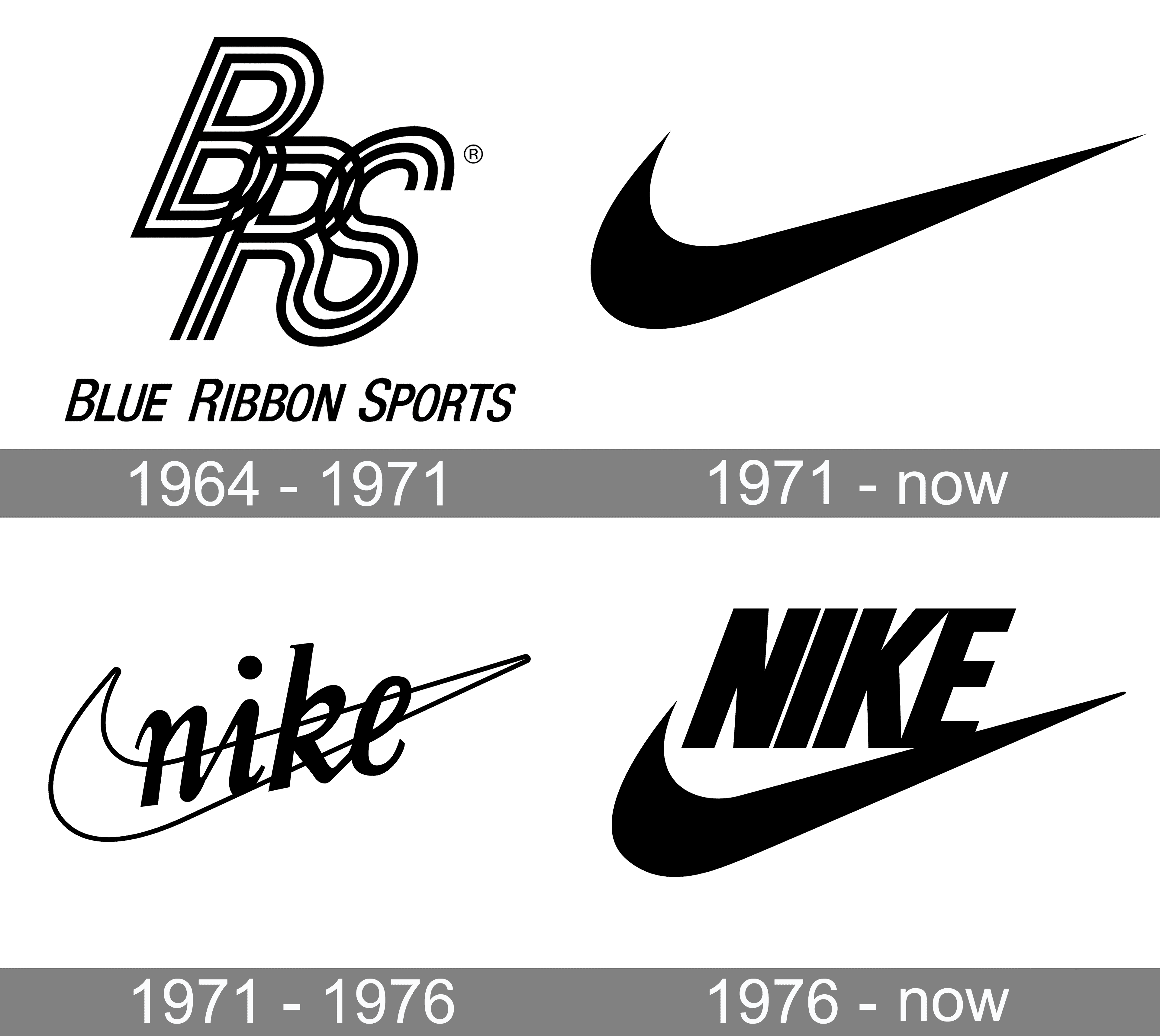
Before the Swoosh badge and the Nike brand itself, the company was called Blue Ribbon Sports and only resold Japanese Tiger sneakers. The company’s logo first appeared in 1964 and featured a combination of a modest sans-serif inscription and a stylized abbreviation. The text was placed under the interlacing letters “BRS”, contoured and merged, with all three characters inclined to the right, just like the name of the company, written at the bottom of the composition. The first “B” was separated from two other letters, overlapping the upper part of the “R” on the left. At the same time, the “R” was smoothly merging into “S”, which also overlapped it, but on the right. Although the composition only contained three letters and was executed in the black and white palette, it looked quite complicated, this is why the underline was made pretty simple: an italicized uppercase inscription in a simple sans-serif.
Is daur me company me kya hua
1964 – 19712 events
1960
According to Otis Davis, a University of Oregon student-athlete coached by Bowerman and Olympic gold medalist at the 1960 Summer Olympics, his coach made the first pair of Nike shoes for him, contradicting a claim that they were made for Phil Knight. History
1967
In 1967, due to increasing sales, BRS expanded retail and distribution operations on the East Coast, in Wellesley, Massachusetts. History
1971 – 1976
Logo #2 of 4 · ~5 saal chala
· pichhle logo ke 7 saal baad
Logo me kya badla
Another Swoosh from 1971 was contoured in black and overlapped by a bold lowercase cursive wordmark, set a bit diagonally against a white background, which only enhanced the sense of motion and speed, conveyed in the original idea of the logo. This was the logo, used for the shortest period in the history of the brand, yet it still had its charm and reflects the old-school style of some of the Nike current sneakers models.
Is daur me company me kya hua
1971 – 19767 events
1971
In 1971, Bowerman used his wife's waffle iron to experiment on rubber to create a new sole for track shoes that would grip but be lightweight and increase the runner's speed. History
1971
Tension between BRS and Onitsuka Tiger increased in 1971 as the latter attempted a takeover of BRS by extending an ultimatum proposal that would give the Japanese company 51 percent of BRS. History
1971
1971 Graphic designer Carolyn Davidson created the famous Nike 'Swoosh' logo and sold it to the company for US$35.00. The 1970s
1972
In 1972, the relationship between BRS and Onitsuka Tiger came to an end. History
1972
Bowerman's design led to the introduction of the "Moon Shoe" in 1972, so named because the waffle tread was said to resemble the footprints left by astronauts on the Moon. History
1972
The so-called "Moon Shoes" were designed by Nike co-founder and track coach Bill Bowerman for runners participating in the 1972 Olympics trials. Collectibles
1974
Further refinement resulted in the "Waffle Trainer" in 1974, which helped fuel the explosive growth of Blue Ribbon Sports/Nike. History
1971 – 1976
Logo #3 of 4 · ~5 saal chala
· pichhle logo ke 0 saal baad
Logo me kya badla
The year 1971 was one of, if not the most important year for Nike, then definitely one of. This is when the iconic Swoosh logo was created by Carolyn Davidson. Even though the legendary emblem has had many different interpretations throughout the years, that original solid black swoosh on a white background without any additional strokes or details, has always been with the company. This is one of those badges, inscribed into the visual identity history book with golden letters. It has everything a brand’s face might need: simplicity, recognizability, uniqueness and actuality.
Is daur me company me kya hua
1971 – 19767 events
1971
In 1971, Bowerman used his wife's waffle iron to experiment on rubber to create a new sole for track shoes that would grip but be lightweight and increase the runner's speed. History
1971
Tension between BRS and Onitsuka Tiger increased in 1971 as the latter attempted a takeover of BRS by extending an ultimatum proposal that would give the Japanese company 51 percent of BRS. History
1971
1971 Graphic designer Carolyn Davidson created the famous Nike 'Swoosh' logo and sold it to the company for US$35.00. The 1970s
1972
In 1972, the relationship between BRS and Onitsuka Tiger came to an end. History
1972
Bowerman's design led to the introduction of the "Moon Shoe" in 1972, so named because the waffle tread was said to resemble the footprints left by astronauts on the Moon. History
1972
The so-called "Moon Shoes" were designed by Nike co-founder and track coach Bill Bowerman for runners participating in the 1972 Olympics trials. Collectibles
1974
Further refinement resulted in the "Waffle Trainer" in 1974, which helped fuel the explosive growth of Blue Ribbon Sports/Nike. History
1976 – Today
Logo #4 of 4 · ~50 saal chala
· pichhle logo ke 5 saal baad
Logo me kya badla
While in the 1971 version, the Nike inscription was directly on the swoosh, in 1976 it was shifted and placed above it. What’s more, the style of the lettering was dramatically changed — the lowercase cursive turned into a bold geometric sans-serif wordmark in the uppercase. As for the swoosh, in the 1976 version, it was solid black, just like on the initial emblem, created by Carolyn Davidson in 1971. The massive letters and their straight lines and cuts added a sense of stability to the smooth and sharp swoosh, they grounded the emblem, creating an image of a confident and powerful brand, with a very progressive look. Who made the Nike logo? The Nike Swoosh was created in 1971 by Carolyn Davidson, who was studying design at Portland State University. She received $35 for the job, which today equals $217. Nike co-founder Phil Knight, who was an accounting teacher at the University, offered her to design the logo when he heard her complain she didn’t have the money to buy oil painting supplies.
Is daur me company me kya hua
1976 – Today144 events
1976
In 1976, the company hired John Brown and Partners, based in Seattle, as its first advertising agency. History
1979
Nike manufactured its first uniforms for a professional sports team in 1979, when its jersey for the Portland Timbers of the North American Soccer League debuted. History
1979
1979 Nike manufactured its first uniforms for a professional sports team in 1979 when its jersey for the Portland Timbers of the North American Soccer League debuted. The 1970s
1979
Parker had been brand co-president of the company, and joined Nike in 1979. The 2000s
1980
By 1980, Nike had attained a 50% market share in the US athletic shoe market, and the company went public in December of that year. History
1982
In 1982, Nike aired its first three national television ads, created by newly formed ad agency Wieden+Kennedy (W+K), during the broadcast of the New York Marathon. Advertising
1982
In 1982, prolific Liverpool striker Ian Rush became the first footballer to sign a sponsorship deal with Nike. Sponsorship
1983
1983 Nike introduces the Pegasus, the first edition of a successful line of running shoes that continues to this day. The 1980s
1984
Nike also starts making clothing Air Jordans were first introduced in 1984 exclusively for Michael Jordan. The 1980s
1984
The signing of basketball player Michael Jordan in 1984, with his subsequent promotion of Nike over the course of his career, with Spike Lee as Mars Blackmon, proved to be one of the biggest boosts to Nike's publicity and sales. Sponsorship
1985
They were released to the public in April 1985. The 1980s
1987
Nike Air Max is a line of shoes first released by Nike, Inc. in 1987. Sports apparel
1987
Nike was criticized for its use of the Beatles song "Revolution" in a 1987 commercial against the wishes of Apple Records, the Beatles' recording company. Beatles song
1988
Its first acquisition was the upscale footwear company Cole Haan in 1988, followed by the purchase of Bauer Hockey in 1994. Acquisitions
1988
It was agency co-founder Dan Wieden who coined the now-famous slogan "Just Do It" for a 1988 Nike ad campaign, which was chosen by Advertising Age as one of the top five ad slogans of the 20th century and enshrined in the Smithsonian Institution. History
1988
Capitol-EMI countered by saying the lawsuit was "groundless" because Capitol had licensed the use of "Revolution" with the "active support and encouragement of Yoko Ono, a shareholder and director of Apple Records." Nike discontinued airing ads featuring "Revolution" in March 1988. Beatles song
1990
Nike is a major sponsor of the athletic programs at Penn State University and named its first child care facility after Joe Paterno when it opened in 1990 at the company's headquarters. Sponsorship
1990
Beginning in 1990, many protests occurred in big cities such as Los Angeles, Washington, DC and Boston in order to show public outcry for Nike's use of child labor and sweatshops. Sweatshops
1992
Additional product lines were introduced later, such as Air Huarache, which debuted in 1992. Sports apparel
1992
Sulfur hexafluoride is an extremely potent and persistent greenhouse gas that was used to fill the cushion bags in all "Air"-branded shoes from 1992 to 2006. Sulfur hexafluoride
1993
1993 Nike introduces Reuse-A-Shoe, which collects athletic shoes, Nike wins Advertiser of the Year at the Cannes Advertising Festival. The 1990s
1993
Since 1993, Nike has worked on its Reuse-A-Shoe program. Recycling
1994
The Cannes Advertising Festival has named Nike its Advertiser of the Year in 1994 and 2003, making it the first company to receive that honor twice. Advertising
1994
1994 Paolo Maldini and Romário become some of the first players to wear Nike's boots at the FIFA World Cup during that year's edition. The 1990s
1994
Nike is again (also in 1994) named "Advertiser of the Year" by the Cannes Advertising Festival. The 2000s
1995
1995 Nike signs long-term partnerships with the Brazilian and United States soccer teams. The 1990s
1996
Vietnam Labor Watch, an activist group, has documented that factories contracted by Nike have violated minimum wage and overtime laws in Vietnam as late as 1996, although Nike claims that this practice has been stopped. Sweatshops
1996
1996 Nike signs Tiger Woods soon after he gives up his amateur golf status. The 1990s
1997
1997 Nike signs several hockey stars, including Sergei Fedorov and Jeremy Roenick, to endorsement deals to wear their new line of skates, which are noticeably different due to their unique colors and design. The 1990s
1998
1998 Phil Knight commits Nike to standards for its affiliated manufacturing facilities, including: minimum wage; air quality; education programs; expansion of microloan program; factory monitoring; and enhanced transparency of Nike's corporate social responsibility practices. The 1990s
2000
The first was for "The Morning After," a satirical look at what a runner might face on the morning of January 1, 2000, if every dire prediction about the Y2K problem came to fruition. Advertising
2000
2000 Nike Shox cushioning/support system is introduced, initially worn by Vince Carter and others on the US Olympic basketball team. The 2000s
2000
The company ranked 239th in the Forbes Global 2000 companies in 2024.
2000
Nike also has earned the Emmy Award for best commercial in 2000 and 2002. Advertising
2000
Nike has been the official ball supplier for the Premier League since the 2000–01 season. Sponsorship
2001
In 2001, a BBC documentary uncovered occurrences of child labor and poor working conditions in a Cambodian factory used by Nike. Child labor
2002
The second was for a 2002 spot called "Move," which featured a series of famous and everyday athletes in a variety of athletic pursuits. Advertising
2002
2002 Nike purchases Hurley International, an action sports clothing company, for an undisclosed amount. The 2000s
2003
In 2003, Nike paid US$309 million to acquire sneaker company Converse. Acquisitions
2003
2003 Nike acquires once-bankrupt rival Converse for $305 million on July 9. The 2000s
2004
The company acquired Starter in 2004 and soccer uniform maker Umbro in 2007. Acquisitions
2004
2004 Phil Knight steps down as the CEO and President of Nike, but continues as chairman. The 2000s
2005
Annual revenues exceed $12.26 billion 2005 Nike reports annual revenue for fiscal year 2005 (ending May 31) of $13.74 billion, a 12% increase over the previous fiscal year. The 2000s
2005
The city attempted to forcibly annex Nike's headquarters, which led to a lawsuit by Nike, and lobbying by the company that ultimately ended in Oregon Senate Bill 887 of 2005. Headquarters
2005
In late June 2005, Nike received criticism from Ian MacKaye, owner of Dischord Records, guitarist/vocalist for Fugazi and The Evens, and front man of the defunct punk band Minor Threat, for appropriating imagery and text from Minor Threat's 1981 self-titled album's cover art in a flyer promoting Nike Skateboarding's 2005 East Coast demo tour. Minor Threat advertisement
2005
Nike was the official kit sponsor for the Indian cricket team from 2005 to 2020. Sponsorship
2006
The Air Zoom Vomero running shoe, introduced in 2006 and currently in its 11th generation, featured a combination of groundbreaking innovations including a full-length air cushioned sole, an external heel counter, a crashpad in the heel for shock absorption, and Fit Frame technology for a stable fit. Sports apparel
2006
Nike reports annual revenue for fiscal year 2006 (ending May 31) of $15 billion. The 2000s
2006
2006 Nike enters the cricket market with a 5-year sponsorship of the Indian cricket team for US$43m. The 2000s
2006
The brand took over for Adidas, who provided the uniforms for the league since 2006. NBA uniform deal
2007
In 2007, New England–based environmental organization Clean Air-Cool Planet ranked Nike among the top three companies (out of 56) in a survey of climate-friendly companies. Environmental record
2008
In 2008, Nike introduced the Air Jordan XX3, a high-performance basketball shoe designed with the environment in mind. Sports apparel
2008
In 2008, a project through the University of North Carolina at Chapel Hill found workers were exposed to toxic isocyanates and other chemicals in footwear factories in Thailand. Toxic chemicals
2008
Nike reports annual revenue for fiscal year 2008 (ending May 31) of $18.6 billion, a 14% increase over the previous fiscal year Dwyane Wade moves from one Nike subsidiary to another, switching from Converse to Jordan Brand. The 2000s
2008
A campaign that Nike began for Earth Day 2008 was a commercial that featured basketball star Steve Nash wearing Nike's Trash Talk Shoe, which had been constructed in February 2008 from pieces of leather and synthetic leather waste from factory floors. Recycling
2008
Some athletes, scientists, and fans have compared this to the 2008 LAZR swimsuit controversy. Vaporfly controversy
2009
2009 Nike sells its Nike Bauer hockey equipment division. The 2000s
2010
Its profits were not declared in Europe and came to light only because of a mostly unrelated case in US Tax Court, where papers filed by Nike briefly mention royalties in 2010, 2011 and 2012 totaling $3.86 billion. Paradise Papers
2010
Nike become the apparel sponsor of Manchester United until 2010. The 2000s
2011
In July 2011, environmental group Greenpeace published a report regarding water pollution impacting the Yangtze River emitted from a major textile factory operated by Nike supplier Youngor Group. Water pollution
2011
As of July 2011, Nike stated that two-thirds of its factories producing Converse products still do not meet the company's standards for worker treatment. Sweatshops
2011
A July 2011 Associated Press article stated that employees at the company's plants in Indonesia reported constant abuse from supervisors. Sweatshops
2011
Sports, Kaepernick and Nike agreed to a new contract despite the fact Kaepernick has been with the company since 2011 and said that "interest from other shoe companies" played a part in the new agreement. Colin Kaepernick
2012
In 2012, Nike is listed as a partner of the (PRODUCT)RED campaign together with other brands such as Girl, American Express, and Converse. Causes
2012
After the Freeh Report was released on July 12, 2012, Nike CEO Mark Parker announced the name Joe Paterno would be removed immediately from the child development center. Sponsorship
2012
In 2012, Nike carried a commercial partnership with the Asian Football Confederation. Sponsorship
2012
2012 Nike introduces Flyknit, a threading technology allowing lighter and more breathable shoe upper. The 2010s
2013
On February 21, 2013, Nike announced it suspended its contract with South African limbless athlete Oscar Pistorius, due to him being charged with premeditated murder. Sponsorship
2013
Nike was made a member of the Dow Jones Industrial Average in 2013, when it replaced Alcoa. Finance
2013
On December 19, 2013, Nike's quarterly profit rose due to a 13 percent increase in global orders for merchandise since April of that year. Finance
2013
In January 2013, Nike signed Rory McIlroy, the then No 1 golfer in the world to a 10-year sponsorship deal worth $250 million. Sponsorship
2014
In August 2014, Nike announced that it will not renew its kit supply deal with Manchester United after the 2014–15 season, citing rising costs. Sponsorship
2014
In April 2014, one of the biggest strikes in mainland China took place at the Yue Yuen Industrial Holdings Dongguan shoe factory, producing amongst others for Nike. Strike in China factory
2014
Under an arrangement with Dutch authorities, the tax break was to expire in 2014, so another reorganization transferred the intellectual property from the Bermudan company to a Dutch commanditaire vennootschap or limited partnership, Nike Innovate CV. Paradise Papers
2015
In 2015, a new self-lacing shoe was introduced. Street fashions
2015
Phil Knight announced in mid-2015 that he would step down as chairman of Nike in 2016. History
2015
In November 2015, Nike announced it would initiate a $12 billion share buyback, as well as a two-for-one stock split, with shares to begin trading at the decreased price on December 24. Finance
2015
Since the start of the 2015–16 season, Adidas has manufactured Manchester United's kit as part of a world-record 10-year deal worth a minimum of £750 million. Sponsorship
2015
Nike consolidated its position in basketball in 2015 when it was announced that the company would sign an 8-year deal with the NBA, taking over from the league's previous uniform sponsor, Adidas. Sponsorship
2015
In June 2015, Nike signed an 8-year deal with the NBA to become the official uniform supplier for the league, beginning with the 2017–18 season. NBA uniform deal
2015
While emissions of Nike's two corporate jets represent less than 0.1% of its total emissions, they have increased by 20% from 2015 to 2023. Carbon footprint
2016
In 2016, a study done by RTG Consulting Group reflected that Nike was the 3rd most relevant brand for Gen-Z in China. Research
2016
He officially stepped down from all duties with the company on June 30, 2016. History
2016
Nike's 2016 decision to exit the golf equipment business–such as club manufacturing–due to an 8.2% decline sales in one year meant sponsored athletes exclusively wore Nike apparel. Sponsorship
2016
Back in 2016, Nike started to use water free dyeing materials so that they can help reduce their water use in their Southeast Asian factories. Water pollution
2017
The Nike Vaporfly first came out in 2017 and their popularity, along with its performance, prompted a new series of running shoes. Nike Vaporfly
2017
In March 2017, Nike announced its launch of a plus-size clothing line, which will feature new sizes 1X through 3X on more than 200 products. Street fashions
2017
The purchase price was the highest for one pair of sneakers, the previous record being $190,373 in 2017 for a pair of signed Converse shoes in California, said to have been worn by Michael Jordan during the 1984 basketball final of the Olympics that year. Collectibles
2017
In 2017, it was estimated that 28,000,000 shoes were collected since its start in 1993. Recycling
2017
The deal required all franchise team members to wear jerseys and shorts with the Swoosh logo, beginning with the 2017/18 season. Sponsorship
2017
According to a study done in 2017, Nike contributed 3,002,529 metric tons of Carbon Dioxide in 2017 combined from different sectors in the company like retail, manufacturing, management, and more. Carbon footprint
2017
On November 5, 2017, the Paradise Papers, a set of confidential electronic documents relating to offshore investment, revealed that Nike is among the corporations that used offshore companies to avoid taxes. Paradise Papers
2017
These updates came in response to criticisms concerning technology in the Nike Vaporfly running shoes, which had been submitted beginning around 2017–2018. Vaporfly controversy
2017
2017 Nike introduces the HyperAdapt 1.0 which were inspired from the Air Mags in the and designed by - Ndima Mbambalala Back to the Future Part II movie. The 2010s
2017
Previously, in 2017, the Nike brand was valued at $29.6 billion.
2018
In a company public announcement on March 15, 2018, Nike CEO Mark Parker said Trevor Edwards, a top Nike executive who was seen as a potential successor to the chief executive, was relinquishing his position as Nike's brand president and would retire in August. History
2018
Nike acquired Zodiac, a consumer data analytics company, in March 2018. Acquisitions
2018
Nike ranked 89th in the 2018 Fortune 500 list of the largest United States corporations by revenue.
2018
In June 2018, Nike announced it would initiate a $15 billion share buyback over four years, to begin in 2019 upon completion of the previous buyback program. Finance
2018
For the fiscal year 2018, Nike reported earnings of US$1.933 billion, with annual revenue of US$36.397 billion, an increase of 6.0% over the previous fiscal cycle. Finance
2018
In September 2018, Nike announced it had signed former American football quarterback Colin Kaepernick, noted for his controversial decision to kneel during the playing of the US national anthem, to a long-term advertising campaign. Colin Kaepernick
2018
Nike's shares traded at over $72 per share, and its market capitalization was valued at over US$114.5 billion in October 2018. Finance
2018
A news report originating from CNN reported that Nike spent $11.5 billion, nearly a third of its sales, on marketing and endorsement contracts in the year 2018. Sponsorship
2019
In August 2019, the company acquired Celect, a Boston-based predictive analytics company. Acquisitions
2019
In 2019, Nike began a program called "Move to Zero" in an effort to achieve zero waste and zero carbon in the organization's supply chain and product lifetime. Sustainability
2019
In November 2019, the company stopped selling directly through Amazon, focusing more on direct relationships with customers. History
2019
On July 23, 2019, a pair of Nike Inc. running shoes sold for $437,500 at a Sotheby's auction. Collectibles
2019
He claimed that after Houston Rockets general manager Daryl Morey was criticized by the Chinese government for his tweet supporting the 2019 Hong Kong protests, Nike removed Rockets merchandise from its stores in China. Hong Kong protests
2020
In 2020, the brand alone was valued in excess of $32 billion, making it the most valuable brand among sports businesses.
2020
Following the report, Nike, as well as Adidas, Puma, and a number of other brands included in the report announced an agreement to stop discharging hazardous chemicals by 2020. Water pollution
2020
As of 2020, Converse is the sole subsidiary of Nike. Acquisitions
2020
In February 2020, the company said that roughly 75% of Nike stores in Greater China had closed due to the COVID-19 outbreak. Finance
2020
However, beginning with the 2020–21 season, the Jumpman replaced the swoosh on the NBA's alternate "Statement" uniforms. NBA uniform deal
2020
Nike reported Total CO2e emissions (Direct + Indirect) for the twelve months ending June 30, 2020 at 317 Kt (+12/+4% y-o-y) and plans to reduce emissions 65% by 2030 from a 2015 base year. Carbon footprint
2020
On January 31, 2020, the World Athletics issued new guidelines concerning shoes to be used in the upcoming Tokyo 2020 Olympics. Vaporfly controversy
2020
In March 2020, Nike reported a 5% drop in Chinese sales associated with stores' closure. Finance
2020
At the same time, the company's online sales grew by 36% during Q1 of 2020. Finance
2020
The components of the shoes are not the only thing that had major changes; starting April 30, 2020, "any shoe must have been available for purchase by any athlete on the open retail market (online or in store) for a period of four months before it can be used in competition". Vaporfly controversy
2021
In February 2021, Nike acquired Datalogue, a New York-based company focused on digital sales and machine learning technology. Acquisitions
2021
Partnership with Newlight In 2021, Nike announced it was working with Newlight Technologies to find more eco-friendly materials for its sneakers. Carbon footprint
2021
In December 2021, Nike purchased RTFKT Studios, a virtual shoe company that makes NFTs. Acquisitions
2021
In December 2021, the European Center for Constitutional and Human Rights filed a criminal complaint in a Dutch court against Nike and other brands, alleging that they benefited from the use of forced Uyghur labor in Xinjiang. Forced Uyghur labor allegations
2022
It is the world's largest supplier of athletic shoes and apparel and a major manufacturer of sports equipment, with revenue in excess of US$46 billion in its fiscal year 2022.
2022
One design by Takashi Murakami was sold for $134,000 in April 2022. Virtual
2023
In 2023, Nike became the presenting sponsor of Reviving Baseball in Inner Cities, which encourages youth in underserved communities to participate in baseball and softball. Causes
2023
In 2023, Nike told ESPN that it would cease using kangaroo skins in its products by the end of that year and debut "a new Nike-only, proprietary synthetic upper, [with] a new material that is a better performance solution and replaces the use of kangaroo leather." Sports apparel
2023
In July 2023, the Canadian Ombudsperson for Responsible Enterprise opened an investigation into Nike to probe allegations of forced Uyghur labor in its supply chain. Forced Uyghur labor allegations
2023
Roth MKM's 2023 Millennial survey reported in March that millennials with health and wellness concerns in the aftermath of the pandemic ranked brands like Nike, Adidas and Lululemon as their preferred brands for purchases. Research
2023
In January 2023, a study by Rakuten concluded that Nike was the most popular sportswear brand in the US, followed by Lululemon and Adidas. Research
2023
In July 2023, a study by Kantar found that Americans consider Nike as the Most Inclusive Brands (alongside other top brands like Amazon, and Disney). Research
2023
Following criticism from animal rights groups, Nike declared its intent in 2023 to phase out the use of wool sourced from lambs that had been subjected to mulesing, a controversial practice involving the removal of skin from live lambs. Welfare of animals used in sourcing
2023
Also in 2023, Nike pledged to eliminate the use of kangaroo leather in favor of a synthetic alternative, in response to animal activists' charge that the killing of kangaroos was unethical. Welfare of animals used in sourcing
2023
Research of the social democratic party in the European Parliament, the Sheffield Hallam University and further groups accused Nike in 2023 of using forced labor camps exploiting Muslim Uyghurs in China provided by the Anhui Huamao Group Co., Ltd. for production. Forced Uyghur labor allegations
2024
In October 2024, Nike announced a 12-year global extension of the partnership, retaining exclusive rights to design and manufacture uniforms for the NBA, WNBA and NBA G League through 2037. NBA uniform deal
2024
Nike sponsored Tiger Woods until 2024, and remained on his side amid the controversies that shaped the golfer's career. Sponsorship
2024
2024 Nike signs a controversial kit deal with the German Football Association, marking the end of their 70 year partnership with Adidas. The 2020s
2024
As of 2024, it employed 83,700 people worldwide.
2025
Knight Campus in honor of co-founder Phil Knight. in December 2025, Nike reorganized its senior leadership team, creating a COO and appointing Venkatesh Alagirisamy to the role. History
2025
In June 2025, Nike warned that President Trump's new tariffs on key trading partners could add around $1 billion to its costs this year, causing the company to shift some production out of China to reduce its exposure. Finance
2026
In April 2026, Nike announced it would cut approximately 1,400 workers, or about 2% of its workforce. History
2026
The layoffs were part of a turnaround plan led by CEO Elliott Hill and followed approximately 800 job cuts in January 2026. History
2026
In April 2026, the chief operating officer, Venkatesh Alagirisamy announced a cut of about 1,400 global operations jobs, especially from the technology department as part of Nike's business reorganization. Finance
2026
In April 2026, Nike setup branding, including a billboard with the slogan "You didn’t come all this way for a walk in the park", at Peckham Rye park to coincide with the local parkrun. Exclusionary branding
2026
In January 2026, Nike laid off 775 employees primarily from distribution centres in Tennessee and Mississippi, as it looks to automate processes and boost profits. Human resources
Saare logos ek saath
Design details
Just Do It
The Swoosh is not Nike’s only advertising achievement. The brand’s legendary slogan, “Just Do It”, was ranked the second-best slogan of the 20th century by the American magazine AdAge. And British design agency Sparkloop surveyed a thousand people aged 18 to 65 and found that Just Do It is the most memorable slogan. So when and how was Nike’s second most important advertising element created? In the early 1980s, Nike had a very serious competitor, Reebok. The company emphasized fitness and aerobics, which were rapidly gaining popularity, while Nike remained loyal to athletics. Knight and partners couldn’t help but notice the changing mood in the sporting goods market and decided to target a wider range of people, regardless of age, gender, or fitness level. Nike decided that a powerful promotional campaign would help to become a brand for everyone. Wieden & Kennedy, Nike’s in-house adve…
The Primary Logo
Nike is definitely one of the strongest and most famous brands in history, which has its vision, targets, and approach. The Nike brand is not just a fashion symbol, it is a cultural phenomenon, a success story, and an inspiration to millions of people around the world. Even the logo of the company has a very interesting story, which perfectly shows, that the simplest things can have the strongest impact. It was Nike’s first line of shoes with the iconic Swoosh logo, released in the early 1970s, that changed the world of the sports industry forever. But the story of the Nike visual identity started a bit earlier, in 1964, with the foundation of Blue Ribbon Sports.
Collaborations
During its long history, Nike worked not only on its collections but also collaborated with a lot of stars of professional sports. Today the famous brand has more than a dozen collaborations, each with a different visual identity. Nike skillfully uses the image of sports stars to promote its products. Basketball player Michael Jordan, tennis player Maria Sharapova, and soccer player Ronaldo — are all the faces of the brand. Collaboration with sports stars helps to build Nike’s association with victories and achievements.
1985, Jordan Wings
The history of the Jordan brand began with an iconic model – the Air Jordan 1. In 1984, Olympic champion and famous basketball player Michael Jordan moved to the club “Chicago Bulls”. Nike began to fight to sign a contract with the athlete. After long negotiations, Michael signed a 5-year agreement for $2.5 million. In 1985, the new line launched with the Jordan Wings logo. Shortly after meeting with Jordan’s agent, Nike creative director Peter Moore drew the Wings logo on a cocktail napkin. The idea for the winged logo came from Nike’s creative director Peter Moore. The designer drew it on the back of a napkin on his way home from a meeting with Jordan’s agent.
1988, Jumpman
The famous Jumpman, which can still be seen on the Brand’s products today, appeared in 1988 in the Air Jordan 3 sneakers, while the first two models in the series featured the Jordan Wings emblem. Peter Moore liked the Nike poster of Michael Jordan soaring through the air with a basketball in his left hand, and it appears on the emblem. The 1988 logo was Moore’s attempt to create a symbol that people would immediately recognize and that could stand for his new style.
1989, Bo Jackson
In 1989, Nike developed its trademark for former professional baseball and soccer player Bo Jackson. The company released a series of “Bo knows” videos featuring the athlete, and created a logo with a capital “O” and a capital “B”. This minimalistic and super stylish logo has brought a lot of dividends and recognizability to the brand, which was only starting to conquer the world in the 1980s.