LogoTimeline

Pepsi

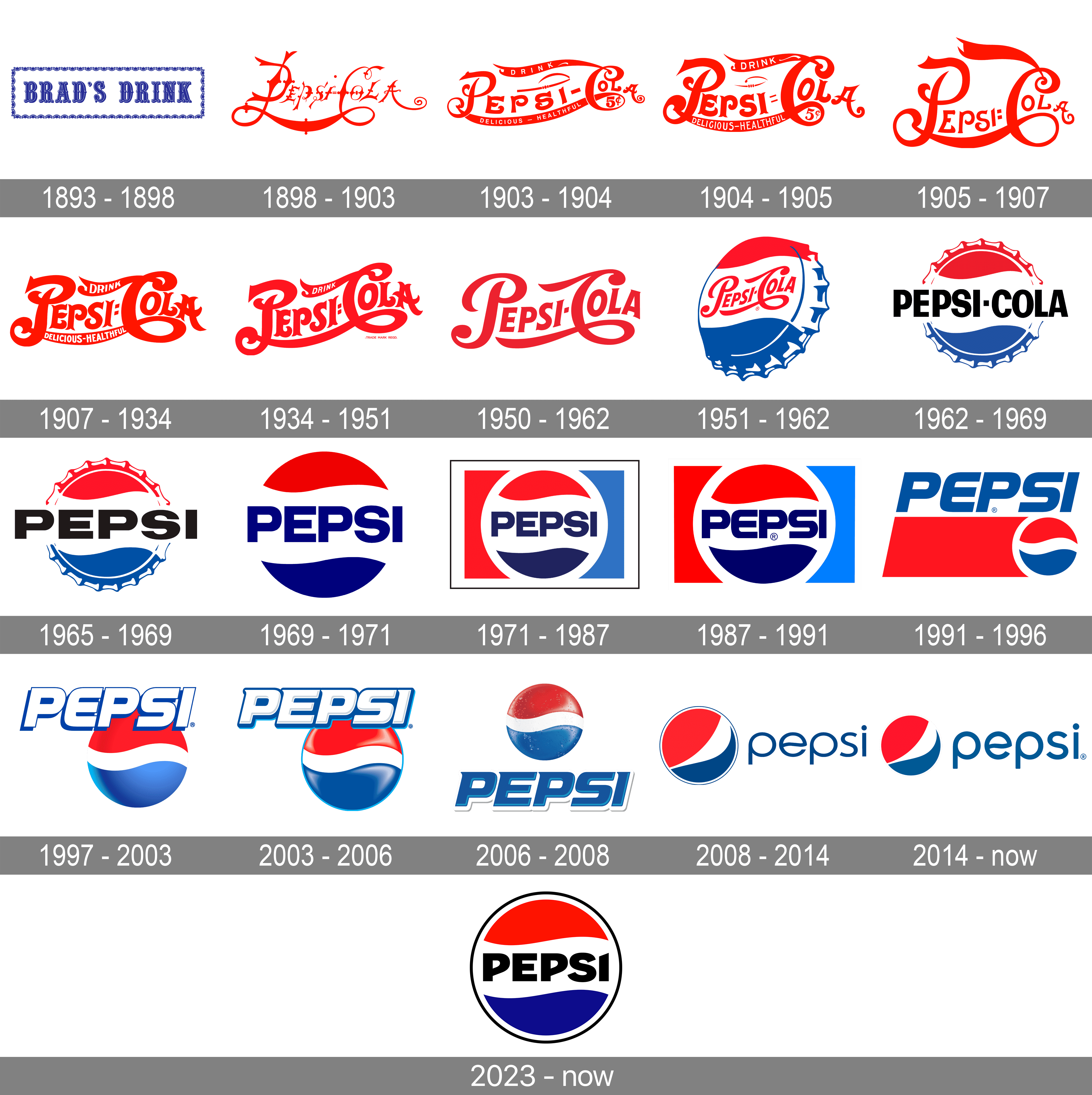
21 logo version 20 baar badla 1893 se shuru 133 saal ka safar sabse lamba chala 1907 – 1934 68 events 50 saal me events mile

Pepsi is not just another beverage, but one of the most famous commercial brands in history, which has changed not only the soft drinks market but the branding design concept in general. The logo of Pepsi is considered one of the most famous and appealing, and many would like to repeat the success of this brand, yet not many succeed. Starting from a small business with a promising idea, Pepsi has become more than just a company, it has turned into a real cultural phenomenon, and a symbol of several generations. The iconic brand, which has been around for more than 100 years has had more than ten redesigns of its visual identity throughout its history. Started as Brad’s Drink in 1893, Pepsi has become synonymous with sweet soda water and no matter what emblem is used, it has always been very well recognized and loved all over the globe. Who designed the Pepsi logo? The iconic Pepsi logotype, written in a custom script typeface, was created by Caleb Bradham, the founder of the company. Back then he chose to write in solid red against a white background. As for the Pepsi Globe, it is more modern, and the first version of the current emblem was developed by the Arnell Group bureaux.

Logo timeline  ·  kisi bhi logo par click karo

Wikipedia par in saalon ka koi event nahi mila: 1903–1908, 1910–1921, 1924–1933, 1935–1939, 1975–1979
Pepsi logo 1893 – 1898

1893 – 1898

Logo #1 of 21  ·  ~5 saal chala

Logo me kya badla

The very first badge of the legendary brand we all know as Pepsi was designed in 1893 when the drink was introduced under the name Brad’s Drink. It was an airy and fresh blue-on-white banner with stylized uppercase lettering written in a fancy contoured wishbone typeface with slightly narrowed capitals against a transparent background and enclosed into a horizontally extended rectangular frame, made of small ornaments, with one side smoothly arched, and the other — curved.

Is daur me company me kya hua 1893 – 1898 2 events
1893
Pepsi was first invented in 1893 as "Brad's Drink" by Caleb Bradham, who sold the drink at his drugstore in New Bern, North Carolina. History
1893
Pepsi, originally created in 1893 by Caleb Bradham and named "Brad's Drink," was first sold in his drugstore in New Bern, North Carolina.
Pepsi logo 1898 – 1903

1898 – 1903

Logo #2 of 21  ·  ~5 saal chala  ·  pichhle logo ke 5 saal baad

Logo me kya badla

The name of the soda was changed to Pepsi-Cola, reflecting its ingredients. And the logo was redesigned to represent the new brand. Now the cursive red lettering with elongated and curved lines was the main and only element of the product’s visual identity.

Is daur me company me kya hua 1898 – 1903 4 events
1898
It was renamed "Pepsi-Cola" in 1898 due to its formula's inclusion of essence of pepsin. History
1898
Renamed "Pepsi-Cola" in 1898 due to its supposed digestive benefits, its name was shortened in marketing to "Pepsi" as early as 1951.
1902
A key selling point in a 1902 advertisement claimed that a glass of Pepsi-Cola contained a teaspoon's worth of the concoction. History
1902
Bradham would incorporate the Pepsi-Cola Company on December 24, 1902, and moved the bottling of Pepsi from his drugstore to a rented warehouse in 1903. History
Pepsi logo 1903 – 1904

1903 – 1904

Logo #3 of 21  ·  ~1 saal chala  ·  pichhle logo ke 5 saal baad

Logo me kya badla

The Pepsi logo, designed in 1903, has only stayed active for a few months. It was a custom red cursive lettering with wishbone details on the characters, and elongated lines, merging into thick red ribbons with white additional wordmarks. The letters in the main logotype were set far from each other, making up a pretty clumsy composition.

Is daur me company me kya hua 1903 – 1904

Is daur ke liye Wikipedia par koi saal-wala event nahi mila.
Pepsi logo 1904 – 1905

1904 – 1905

Logo #4 of 21  ·  ~1 saal chala  ·  pichhle logo ke 1 saal baad

Logo me kya badla

The redesign of 1904 has refined the contours of the fancy characters in the Pepsi logotype, boldening the lines and cleaning them up. The letters got closer to each other, creating a more confident and professional look at the badge. As for the main element of the logo, its red color, it remained unchanged.

Is daur me company me kya hua 1904 – 1905

Is daur ke liye Wikipedia par koi saal-wala event nahi mila.
Pepsi logo 1905 – 1907

1905 – 1907

Logo #5 of 21  ·  ~2 saal chala  ·  pichhle logo ke 1 saal baad

Logo me kya badla

The logo was redesigned again in 1905 and started resembling a causal identity of the brand’s main competitor, Coca-Cola. It was a bold script lettering in red, with a curved long tail of the letter “C”, and the connected lines of “P” and “C”, underlining the whole logotype and creating a double loop pattern.

Is daur me company me kya hua 1905 – 1907

Is daur ke liye Wikipedia par koi saal-wala event nahi mila.
Pepsi logo 1907 – 1934

1907 – 1934

Logo #6 of 21  ·  ~27 saal chala  ·  pichhle logo ke 2 saal baad

Logo me kya badla

The concept, introduced in 1904 was brought back to the Pepsi badge in 1907, with the contours of all elements modified and made more confident and clean. All characters got thicker, hence the red color of the inscription started looking even more intense and powerful.

Is daur me company me kya hua 1907 – 1934 4 events
1909
In 1909, automobile race pioneer Barney Oldfield was the first celebrity to endorse Pepsi, describing it as "A bully drink...refreshing, invigorating, a fine bracer before a race." The advertising theme "Delicious and Healthful" was then used over the next two decades. History
1922
On three occasions between 1922 and 1933, the Coca-Cola Company was offered the opportunity to purchase the Pepsi-Cola Company, which it declined on each occasion. History
1923
In 1923, the Pepsi-Cola Company entered bankruptcy—in large part due to financial losses incurred by speculating on the wildly fluctuating sugar prices as a result of World War I. History
1923
Early on, Pepsi struggled with financial stability, going bankrupt in 1923 but was subsequently purchased and revived by Charles Guth, who reformulated the syrup.
Pepsi logo 1934 – 1951

1934 – 1951

Logo #7 of 21  ·  ~17 saal chala  ·  pichhle logo ke 27 saal baad

Logo me kya badla

In 1934 the red inscription was refined and the thin delicate “Drink” inscription was added on the upper line of the letter “C”. This logo looked more confident and solid than the previous versions, with thicker lines. It was placed slightly diagonally, adding a sense of movement and progress.

Is daur me company me kya hua 1934 – 1951 4 events
1934
During the Great Depression, Pepsi gained popularity following the introduction in 1934 of a 12-ounce (355 mL) bottle. Growth in popularity
1940
With a radio advertising campaign featuring the popular jingle "Nickel, Nickel" – first recorded by the Tune Twisters in 1940 – Pepsi encouraged price-conscious consumers to double the volume their nickels could purchase. Growth in popularity
1945
The Pepsi-Cola name would be shortened to simply "Pepsi" as early as 1945, when their bottles transitioned from standard paper labels to the applied color label (ACL) process, which involved screen-printing enamel paint graphics directly onto the bottle at a high temperature. Growth in popularity
1950
In a national meeting, Mack tried to assuage the 500 bottlers in attendance by pandering to them, saying "We don't want it to become known as a nigger drink." After Mack left the company in 1950, support for the black sales team faded and it was cut. Niche marketing
Pepsi logo 1950 – 1962

1950 – 1962

Logo #8 of 21  ·  ~12 saal chala  ·  pichhle logo ke 16 saal baad

Logo me kya badla

The redesign of 1950 made the logotype look more professional and modern. All the extra lines were removed and the inscription was now bolder and eater. This was the last version in the minimalist red and white color palette. In 2014 the logo started to be used by the company again, and it still can be seen on the products today, just on the backside.

Is daur me company me kya hua 1950 – 1962 7 events
1950
In a national meeting, Mack tried to assuage the 500 bottlers in attendance by pandering to them, saying "We don't want it to become known as a nigger drink." After Mack left the company in 1950, support for the black sales team faded and it was cut. Niche marketing
1951
This motif would be carried over when a new bottle design and logo were introduced in mid-1951. Growth in popularity
1952
These helped make Pepsi-Cola a popular product in many markets, including in the Middle East following the opening of a plant in Cairo, and the Beirut Daily Star referred to the "Pepsi-Cola culture" when distribution began in Lebanon in 1952. Second half of the 20th century
1954
One example is Pepsi's 1954 "Pepsi Day at the Beach" event, where New Orleans children could ride rides at an amusement park in exchange for Pepsi bottle caps. Niche marketing
1956
Combined with company and production changes, Pepsi sales had boomed by 1956 and gradually narrowed the gap to its large competitor. Second half of the 20th century
1958
In 1958, the "swirl" design bottle began to be used for distributing Pepsi. Second half of the 20th century
1959
When Steele died in 1959, Crawford was appointed to the Board of Directors of Pepsi-Cola, a position she held until 1973, although she was not a board member of the larger PepsiCo, created in 1965. Marketing
Pepsi logo 1951 – 1962

1951 – 1962

Logo #9 of 21  ·  ~11 saal chala  ·  pichhle logo ke 1 saal baad

Logo me kya badla

The prototype of the next generation Pepsi logo was introduced in 1951. It was an image of the metal bottle cap, colored in red, white, and blue, with the red script lettering from the previous version, placed on the white part of the cap.

Is daur me company me kya hua 1951 – 1962 6 events
1951
This motif would be carried over when a new bottle design and logo were introduced in mid-1951. Growth in popularity
1952
These helped make Pepsi-Cola a popular product in many markets, including in the Middle East following the opening of a plant in Cairo, and the Beirut Daily Star referred to the "Pepsi-Cola culture" when distribution began in Lebanon in 1952. Second half of the 20th century
1954
One example is Pepsi's 1954 "Pepsi Day at the Beach" event, where New Orleans children could ride rides at an amusement park in exchange for Pepsi bottle caps. Niche marketing
1956
Combined with company and production changes, Pepsi sales had boomed by 1956 and gradually narrowed the gap to its large competitor. Second half of the 20th century
1958
In 1958, the "swirl" design bottle began to be used for distributing Pepsi. Second half of the 20th century
1959
When Steele died in 1959, Crawford was appointed to the Board of Directors of Pepsi-Cola, a position she held until 1973, although she was not a board member of the larger PepsiCo, created in 1965. Marketing
Pepsi logo 1962 – 1969

1962 – 1969

Logo #10 of 21  ·  ~7 saal chala  ·  pichhle logo ke 11 saal baad

Logo me kya badla

The redesign of 1962 simplified and modernized the logo concept, introduced in the 1950s. The tricolor bottle cap got turned straight and the blue cursive lettering was replaced by a bold uppercase inscription in black sans-serif, with the words not fitting the cap’s contours, but coming out of them to both sides. This badge stayed in use by the brand for more than seven years.

Is daur me company me kya hua 1962 – 1969 4 events
1962
When the drink was rebranded in 1962, two versions of the same logo with either name were used interchangeably. Growth in popularity
1963
In 1963, the drink began to be distributed in America in larger 16-ounce (473 mL) bottles, and 12-ounce cans were introduced as well. Second half of the 20th century
1964
Diet Pepsi, a second Pepsi product and the first extending the brand, was launched in 1964. Second half of the 20th century
1966
Pepsi was introduced in Romania in 1966, during the early liberalization policies of Nicolae Ceaușescu, opening a factory at Constanța in 1967. Around the world
Pepsi logo 1965 – 1969

1965 – 1969

Logo #11 of 21  ·  ~4 saal chala  ·  pichhle logo ke 3 saal baad

Logo me kya badla

The tricolor cap continued the main theme of the visual identity in 1965 — it was a background for a black bold “Pepsi” inscription in all capitals of the simple sans-serif typeface, with a modified letter “S”.

Is daur me company me kya hua 1965 – 1969 1 event
1966
Pepsi was introduced in Romania in 1966, during the early liberalization policies of Nicolae Ceaușescu, opening a factory at Constanța in 1967. Around the world
Pepsi logo 1969 – 1971

1969 – 1971

Logo #12 of 21  ·  ~2 saal chala  ·  pichhle logo ke 4 saal baad

Logo me kya badla

In 1969 the Pepsi badge was redesigned again, with the previous logo version modernized and strengthened. The contours of the Pepsi globe got cleaned and minimized, with the “Pepsi” inscription changing its color to deep blue. The contours of the letters were also refined, and getting taller and slightly thinner than on the badge from the middle of the 1960s.

Is daur me company me kya hua 1969 – 1971 3 events
1969
By 1969, the drink would almost exclusively be referred to as "Pepsi", with the full name retained for secondary uses. Growth in popularity
1969
Pepsi machines were also installed in the White House cafeteria when Richard Nixon, who already had a close relationship with Pepsi, assumed the American presidency in 1969. Second half of the 20th century
1970
The Bisons ceased operations in 1970, making way for the Buffalo Sabres of the NHL. Sports sponsorships
Pepsi logo 1971 – 1987

1971 – 1987

Logo #13 of 21  ·  ~16 saal chala  ·  pichhle logo ke 2 saal baad

Logo me kya badla

The more modern version of the visual identity was designed for the company in 1971. The circle with a thick white outline was placed inside a rectangle in a white frame. The left part of the rectangle was red, while the right one — blue. As for the circle, it replicated the pattern of the bottle cap from the previous logos and had a bold blue nameplate placed on its white part.

Is daur me company me kya hua 1971 – 1987 8 events

1972
In 1972, PepsiCo struck a barter agreement with the government of the Soviet Union, in which PepsiCo was granted exportation and Western marketing rights to Stolichnaya vodka in exchange for importation and Soviet marketing of Pepsi. Around the world
1974
Notably, in 1974 Pepsi became the very first American consumer product to be produced, marketed and sold in the Soviet Union. Second half of the 20th century
1980
Although total Pepsi sales never overtook that of Coca-Cola, the latter's lead in the American market had been narrowed to 1½-to-1 as of 1980 (from 5-to-1 in 1950), and Pepsi was outselling its rival in the "take-home" market, which includes supermarkets. Second half of the 20th century
1982
In addition, Caffeine-Free Pepsi has been produced since 1982, and a retro-themed drink made of cane sugar is sold exclusively in North America, called Pepsi Throwback. Variants and portfolio
1984
In 1984, Venezuela was cited as the only country where Pepsi cola sales were higher than Coca-Cola. Around the world
1984
In November 1984, PepsiCo announced that it would, at least in the US, exclusively use high-fructose corn syrup (HFCS) to sweeten its canned, bottled and fountain Pepsi-Cola, replacing cane sugar. Second half of the 20th century
1985
In 1985, The Coca-Cola Company, amid much publicity, changed its formula. Rivalry with Coca-Cola
1986
From 1986 to 2003, the Pepsi wordmark was typeset in a custom treatment of Handel Gothic. Marketing
Pepsi logo 1987 – 1991

1987 – 1991

Logo #14 of 21  ·  ~4 saal chala  ·  pichhle logo ke 16 saal baad

Logo me kya badla

In 1987 the white frame of the logo was removed and the lettering — enlarged. The typeface was also changed to a smoother and sleeker one, with rounded corners of the letter “E”.

Is daur me company me kya hua 1987 – 1991 4 events
1988
In 1988, PepsiCo entered the Indian market by creating a joint venture with the government of Punjab-owned Punjab Agro Industrial Corporation and Voltas India Limited. Around the world
1989
In 1989, Pepsi commissioned a $5 million marketing campaign to coincide with the release of Madonna's song "Like a Prayer", but was cancelled following strong backlash regarding the religious themes in the song's music video. Marketing
1989
In 1989, Billy Joel mentioned the rivalry between the two companies in the song "We Didn't Start the Fire". Rivalry with Coca-Cola
1989
A vitamin-enriched Pepsi variation called "Pepsi Perfect" in a special bottle was shown in the 1989 movie Back to the Future Part II in scenes set in the future year 2015. Fictional drinks
Pepsi logo 1991 – 1996

1991 – 1996

Logo #15 of 21  ·  ~5 saal chala  ·  pichhle logo ke 4 saal baad

Logo me kya badla

The nameplate was placed outside of the circle in 1991. The logo was now composed differently — the inscription in too with the red horizontally placed rectangle under it and the circle in red and blue with a thick white curve in the middle, on the right of the rectangle. In 1996 additional logo was designed — the white inscription on a blue background, using two different shades to create a geometric pattern. The signature circle was replaced by a part of a sphere, placed on the bottom right corner of the logo.

Is daur me company me kya hua 1991 – 1996 6 events
1991
This joint venture marketed and sold Lehar Pepsi until 1991, when the use of foreign brands was allowed; PepsiCo promptly bought out its partners and ended the joint venture in 1994. Around the world
1991
Pepsi did not sell soft drinks in Israel until 1991. Around the world
1992
In 1992, following the dissolution of the Soviet Union, Coca-Cola was introduced to the Russian market and rapidly captured a significant market share due to public perceptions of Coca-Cola as representative of the new post-Soviet system (as opposed to Pepsi being exemplary of the old Soviet era), a market growth that might otherwise have required years to achieve. Around the world
1992
In 1992, the Pepsi Number Fever marketing campaign in the Philippines accidentally distributed 800,000 winning bottle caps for a 1 million peso grand prize, leading to riots and the deaths of five people. Marketing
1993
In 1993, Coca-Cola returned to the Indian market in pursuance of India's liberalization policy. Around the world
1994
Pepsi entered the market in Vietnam in 1994 after the end of an American trade embargo against the country. Around the world
Pepsi logo 1996 – 2003

1996 – 2003

Logo #16 of 21  ·  ~7 saal chala  ·  pichhle logo ke 5 saal baad

Logo me kya badla

The visual identity of the famous soda sting was simplified in 1996. The white wordmark in a bold sans-serif typeface with smooth lines and slightly italicized letters featured a thin blue outline and shadow. The inscription was placed above a three-dimensional emblem, depicting a tricolor sphere. The emblem on this logo was resembling a globe, pointing on the international popularity of the brand.

Is daur me company me kya hua 1996 – 2003 9 events
1996
In 1996, PepsiCo launched the highly successful Pepsi Stuff marketing strategy. Marketing
1996
In 1996, Sega-AM2 released the Sega Saturn version of its arcade fighting game Fighting Vipers. Pepsiman
1996
Pepsiman is an official Pepsi mascot from Pepsi's Japanese corporate branch, which debuted in March 1996. Pepsiman
1997
The Project Blue design was first tested in the United States in June 1997, and was released that December in preparation for Pepsi's 100th anniversary. Marketing
1997
In 1997, after his sponsorship with Coca-Cola ended, retired NASCAR Cup Series driver Jeff Gordon signed a long-term contract with Pepsi, and he drove with the Pepsi logos on his car with various paint schemes for about 2 races each year, usually a darker paint scheme during nighttime races. Sports sponsorships
1997
Pepsi also has been a sponsor of the Carolina Hurricanes of the National Hockey League since the team moved to North Carolina in 1997. Sports sponsorships
1999
In 1999, KID developed a video game for the PlayStation entitled Pepsiman. Pepsiman
1999
From 1999 to 2020, Pepsi also had the naming rights to the Pepsi Center, an indoor sports and entertainment facility in Denver, Colorado, until the venue's new naming rights were announced on October 22, 2020. Sports sponsorships
2002
Pepsi has also sponsored the NFL Rookie of the Year award since 2002. Sports sponsorships
Pepsi logo 2003 – 2006

2003 – 2006

Logo #17 of 21  ·  ~3 saal chala  ·  pichhle logo ke 7 saal baad

Logo me kya badla

The lettering Gaines a new more dynamic shape in 2003, as for the emblem — it was drawn in gradient colors, getting a glossy and vivid look. This logo only stayed with the company for three years, but it still can be seen on the products in some countries across the globe.

Is daur me company me kya hua 2003 – 2006 1 event
2005
By July 2005, Coca-Cola enjoyed a market share of 19.4 percent, followed by Pepsi with 13 percent. Around the world
Pepsi logo 2006 – 2008

2006 – 2008

Logo #18 of 21  ·  ~2 saal chala  ·  pichhle logo ke 3 saal baad

Logo me kya badla

The wordmark was placed under the emblem in 2006. Now it was colored blue and had a thick white outline, while the emblem was drawn in more distinct lines and has a texture with water drops, which added volume and made it look realistic.

Is daur me company me kya hua 2006 – 2008

Is daur ke liye Wikipedia par koi saal-wala event nahi mila.

Pepsi logo 2008 – 2014

2008 – 2014

Logo #19 of 21  ·  ~6 saal chala  ·  pichhle logo ke 2 saal baad

Logo me kya badla

The completely new logo for Pepsi was created in 2008. The emblem was drawn in 2D and the inscription was executed in the lowercase letters. The iconic “globe” now had the white line placed diagonally and featured a thin double outline, composed of white and blue.

Is daur me company me kya hua 2008 – 2014 4 events
2008
In October 2008, Pepsi announced that it would redesign its logo and re-brand many of its products by early 2009. Marketing
2008
According to Beverage Digest's 2008 report on carbonated soft drinks, PepsiCo's U.S. market share is 30.8 percent, while The Coca-Cola Company's is 42.7 percent (this includes all their respective brands). Rivalry with Coca-Cola
2009
In 2009, Pepsi, Diet Pepsi, and Pepsi Max began using all lower-case fonts for name brands. Marketing
2012
As of 2012, Pepsi is the third most popular carbonated drink in India, with a 15% market share, behind Sprite and Thums Up. Around the world
Pepsi logo 2014 – 2023

2014 – 2023

Logo #20 of 21  ·  ~9 saal chala  ·  pichhle logo ke 6 saal baad

Logo me kya badla

The recent insignia of the brand was designed in 2014 and is one of the most minimalist versions in the company’s history. The emblem, placed on the left of the wordmark has its frame removed and now looks modern and solid. As for the lettering, it is still in the lowercase, and the “E” of the custom sans-serif typeface resembles a white wave from the iconic emblem.

Is daur me company me kya hua 2014 – 2023 6 events

2014
This logo was also used for Pepsi Throwback until 2014. Marketing
2015
Pepsi has the first global sponsorship deals with the UEFA Champions League and the UEFA Women's Champions League starting in the 2015–16 season along with the sister brand, Pepsi Max and became the global sponsor of the competition. Sports sponsorships
2015
It was the sponsor of Major League Soccer until December 2015 and Major League Baseball until April 2017, both leagues signing deals with Coca-Cola. Sports sponsorships
2015
This was in 2015 released as a limited-edition drink. Fictional drinks
2017
In 2017, Pepsi was the jersey sponsor of the Papua New Guinea national basketball team. Sports sponsorships
2021
It replaced the original formulation in many regions including Argentina and across Europe since at least 2021, with sugar being reduced by over one third from approximately 10.7 g to 7.0 g (per 100 mL) in some countries, while in Western Europe sugar was cut by more than half, to 4.6 g per 100 mL. Ingredients
Pepsi logo 2023 – Today

2023 – Today

Logo #21 of 21  ·  ~3 saal chala  ·  pichhle logo ke 9 saal baad

Logo me kya badla

The Pepsi company did not invent anything new when it updated the logo to celebrate its 125th anniversary. The emblem introduced back in 1987 served as the basis. They took the round portion of it and added a black outline around it to make it stand out on any background. To support the addition of the black, they also used it for the inscription, which featured a slightly different custom font. The letters have a slanted style and no serifs. The logo turned out great as it is a perfect blend of the long history of the brand and modern design elements.

Is daur me company me kya hua 2023 – Today 3 events

2023
In 2023, Pepsi was the second most valuable soft drink brand worldwide behind Coca-Cola; the two share a long-standing rivalry in what has been called the "cola wars".
2024
As of 2024, Pepsi had fallen behind Coca-Cola and Dr Pepper as the third most popular soft drink in the United States, losing its second place spot to the aforementioned Dr Pepper, a position it had held since 1985. Rivalry with Coca-Cola
2025
The new formulation also came into effect in Australia in 2025 (with sugar reduced by one-third) The change was done as part of PepsiCo's pro-health commitment across all its brands, as well as the increasing sugar taxes and regulations all around the world. Ingredients

Saare logos ek saath

Pepsi logo history

Design details

Font

The wordmark features a custom-made italicized roman type, which is called Pepsi Light. If you are looking for a more popular typeface that looks close to the Pepsi insignia, you may try Harry Plain font.

Font

Color

The combination of colors used by Pepsi symbolizes the product’s core emotional values. According to consumer research, dark royal blue, which is featured in the original beverage, conveys the idea of “cool”. The lighter shade that can be seen in Pepsi Max, associates with “cool and fresh”, while golden shade seen in the Caffeine Free version symbolizes balance and energy. Why is the Pepsi logo effective? The Pepsi logo is not just a graphic emblem that does not carry any meaning and only represents a bright picture. It is a symbol of growth and progress, expansion and novelty, for the depiction of which the designers were able to find the perfect shape and color solution. Why did Pepsi add blue to its logo? The company’s logo gained blue color at the beginning of the 1950s, as an element, distinguishing Pepsi from its main competitor, Coca-Cola, as before that the logos of the two bran…